No model to rule them all
Carbon & GHG models turning

In the late 2010s, I was the product lead for the FieldView platform at the Climate Corporation (now part of Bayer Crop Science). The FieldView platform team was in search of partners to plug into the FieldView ecosystem. The hypothesis was that the ecosystem will create new incremental value for FieldView customers in the long term. There was no shortage of drone imagery providers, and soil testing organizations. The technology for drone imagery was fascinating but the ROI was difficult to non-existent.
Around the same time, carbon based companies started to show up in conversations. One of our earliest conversations was with Nori. Nori was an interesting company targeting carbon sequestration in natural systems like agriculture. (I used the past tense for Nori, as Nori shut down about a week ago.)
Thanks for reading Software is Feeding the World! Subscribe for free to receive new posts and support my work.
Our team had talked with quite a few carbon companies by then, but Nori’s approach seemed a bit different as they planned to price the quality of the sequestered carbon into their equation.
There were other players out there as well like Fluorosat (which was renamed to ReGrow), Aspiring Universe (which is now called Habiterre), Indigo, ESMC etc. In fact, talking about carbon became as common as people starting Substack newsletters in 2020. As you all know, Indigo has had their fair share of troubles, ReGrow has bemoaned the slow adoption of certain practices.
I also wrote a tongue in cheek piece titled “Carbon is the Substack of Agriculture” in 2020.
The high level idea is simple. Someone will pay farmers to sequester carbon and create a market of suppliers and buyers for carbon.
Scientists with the World Resources Institute argue that many regenerative agriculture practices can in fact improve soil health “and yield some valuable environmental benefits, but are unlikely to achieve large-scale emissions reductions.
On the tech side, the methods and processes to measure carbon stock and flow are nascent, and need to become much more consistent and reliable, to support an open, transparent and functional market.
Natural systems like agriculture are very difficult for soil carbon sequestration due to the principles of additionality, and permanence. A ton of carbon sequestered in the soil today due to some change in management practice is not guaranteed to be sequestered for ever, if a few years down the line, the farm operator decides to do a tillage operation.
Over the last few years, many process or mechanistic models have been developed, which not only can look at carbon levels, but can also estimate greenhouse gas emissions based on the farming system and management practices used. Before we go into some of the existing models, let us do a quick look at what are some of the key greenhouse gasses.
A quick primer on Greenhouse Gases
Carbon dioxide is the most abundant GHG, and the most significant driving climate change. Human activities released 37.4 billion tons of carbon dioxide in the atmosphere in 2023, with the largest source being power plants, followed by transportation, and then industrial activities.
Methane is a powerful contributor, making up about 30% of the warming we’ve experienced to date, even though carbon dioxide is roughly 200 times more abundant in the atmosphere. Methane’s largest sources are the fossil-fuel industry, agriculture, and waste.
Nitrous oxide emissions come almost entirely from agriculture, and the gas makes up about 6% of warming to date. Nitrous oxide emissions grew roughly 40% from 1980 to 2020. The gas lasts in the atmosphere for roughly a century, and over that time it can trap over 200 times more heat than carbon dioxide does in the same period.
Fluorinated gasses are some of the most powerful greenhouse gasses we emit. They last for centuries (or even millennia) in the atmosphere and have some eye-popping effects, with each having at least 10,000 times more global warming potential than carbon dioxide. SF6 is used in high-voltage power equipment. It is the single worst greenhouse gas and is 23,500 times more powerful than carbon dioxide over the course of a century.
No model to rule them all
Many organizations started building models to monitor and predict carbon, and other GHG levels based on certain management practices. The key models built during the period were COMET (used by Indigo), DNDC (used by ReGrow), and Ecosys (used by Habiterre). These models are typically process models used to power MRV (Measure, Report, and Verify) platforms.
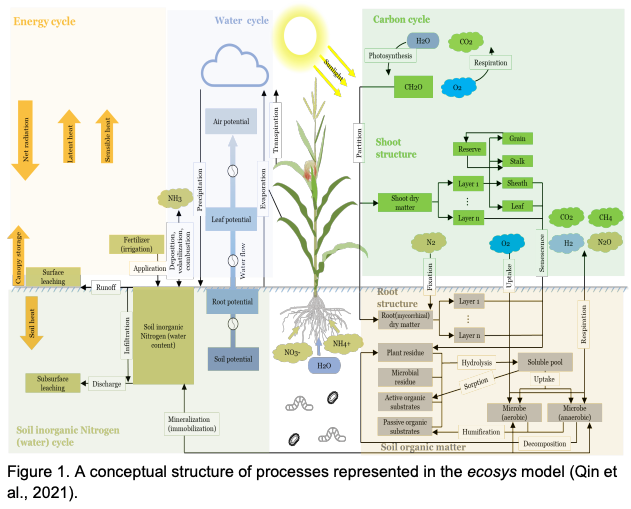
For example, HabiTerre has built the Ecosys model to simulate Soil Organic Carbon (SOC) changes and direct nitrous oxide (N2O) emissions from soil under different conservation land management practices in annual row crop systems. Ecosys is a process based model, which models different cycles like the energy cycle, water cycle, carbon cycle, etc.
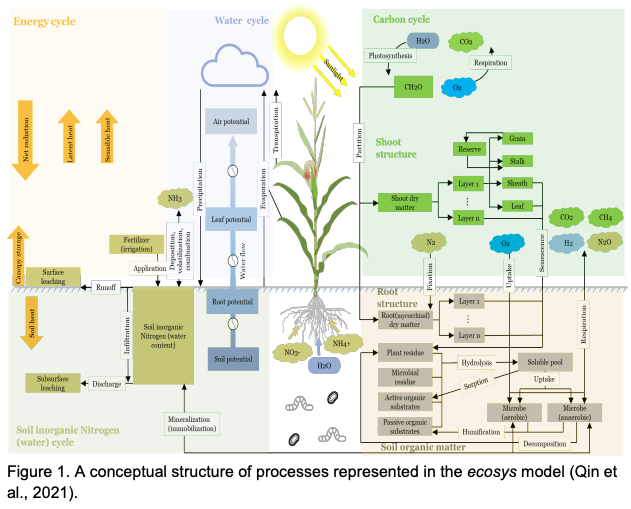
Image source: Validation Report of the Ecosys Model Version 1.0
As you can see from the schematic diagram above, the Ecosys model is a sophisticated model which uses,
Data streams from 20+ different satellites are processed with our fusion algorithms, which eliminate gaps in the data and remove the effects of clouds. This data is integrated with information gathered from sensors mounted on airplanes, automobiles, and ground sensor networks.
Integration of all of this information is made possible by our proprietary algorithms, which have been verified with actual “ground truth” information, creating a quantitative analysis of individual fields at a 30-meter (100-foot) resolution and at a daily frequency, recording the past 20+ years. Habiterre then applies their scientific models and proprietary algorithms to evaluate crop growth conditions (photosynthesis, biomass, growth stage, crop yield), water use, biochemical status (nitrogen and phosphorus content), and management practices (planting/harvesting time, field boundaries, crop type, cover crop growth, crop residue, and tillage).
These models are sophisticated, powerful, and at the same time rely on a large volume of high quality and accurate data which goes back many years to build a baseline model and calibrate.
For example, the Ecosys model needs the following data elements to start. This data set is challenging to get to due to lack of management practice information, soil and atmospheric conditions etc.
Due to the lack of availability and the quality of data to feed into the model, the error bars on the process model can be big.
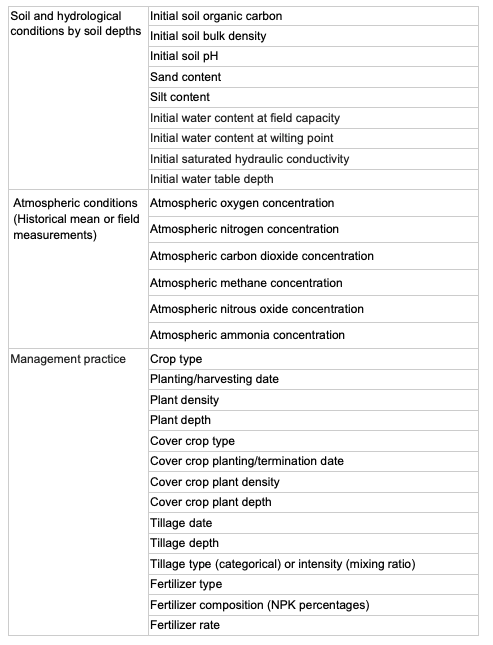
There could be some potential challenges in scaling the model from one region to the next. Many of these models require extensive ground truth data to recalibrate the model. As you can see from the data needs, it is very challenging to deploy the model to a new region or planting system.
Oftentimes there is not enough ground truth data or it is very expensive to get the ground truth data, to tweak the model for a different region or a cropping system.
The DNDC model from ReGrow has similar data requirements, which includes large amounts of data around farm management practices. As we all know, the farm management data systems do not have good quality data to run and calibrate these models effectively.
DNDC takes data about emissions and carbon sequestration (how much carbon is stored in the soil) for agricultural systems, and uses that data to predict how emissions may change as producers adjust their farming practices.
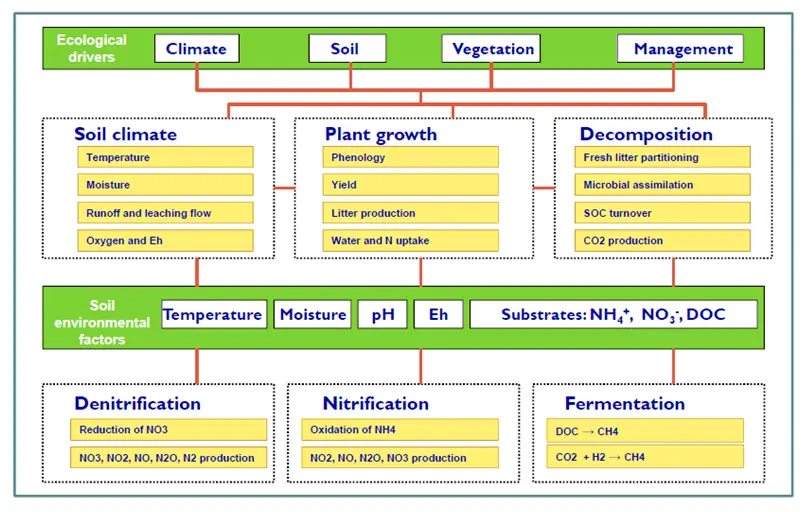
Image source: “The Science behind Quantifying Emissions”
The story is not very different for nature based carbon credits. A few months ago, The Guardian had published an article saying 90% of projects certified under Verra, did not represent real emissions reductions.
According to EDF, these sophisticated models developed by scientists to quantify variables like soil carbon stocks provide
little evidence that existing models can accurately capture soil organic carbon change at the field level under all proposed management interventions for all combinations of soils and climate.
For example, soil sampling is often done to verify and calibrate these models. Soil sampling has challenges due to the variability in the soil. Different soil structures and textures can significantly impact the amount of carbon stored and the accuracy of sampling only a subset of fields.
For example, if you want to take soil samples in the corn, soy, wheat areas of the US, you would require 250 million acres / 2.5 acres per sample = 100 million samples.
At $ 50 per soil test, it would cost about $ 5 billion to get soil sample results across the commodity row crop properties. Even if methods like latin hypercube sampling are used to reduce the number of samples by a 100, you would still need $ 5 billion / 100 = $ 50 million.
As you can see, no one is making this investment to draw a detailed map of soil properties in the US. The lack of good quality ground truth data, whether it is soil samples or management practice data is a big hurdle to build accurate models, which can be wrapped inside a feasible business model for the farmer, and other agribusinesses.
Show me the money
According to Habiterre, which recently closed its $ 10m first close on its Series A, the market around environmental outcomes in ag is real. It is struggling to realize its potential because of the inefficiencies of data, and lack of confidence in the generated outcomes. The lack of a clear business model, and how it helps the farmer be better.
Many companies like Bayer have been pushing regenerative agriculture, but as discussed above the financial and business models are not very clear or require some de risking for the grower as many of the benefits of regenerative agriculture take a few years to realize.
Agribusinesses have been funding some of the transition through incentives for cover crops, and other management practice changes. Farmers are adopting these practices due to agronomic benefits or government incentives by lowering their carbon intensity scores.
Companies like Vayda are using a service based show-and-tell approach to quantify and show the agronomic benefits of adoption of certain practices, within the context of a given farming operation. They are able to turn this information and data into actual paying customers by helping them with some of the regenerative practice transition.
If there is so much uncertainty around the business model and the technology for the carbon and GHG models, what is the rationale for Deere to lead an investment in Habiterre?
My current hypothesis is that Deere wants to stay engaged with the carbon and GHG emissions markets. It will help them understand how and what kind of data is needed by these models. Can Deere be a provider of this data?
If and when regulations become tighter around reporting on the types of activities being performed on the field, the types of inputs applied, Deere will be in a better position to understand those needs in the future.
By staying engaged Deere gets a front row seat of this model development, calibration, deployment, and use. They can also get a better sense of the types of data needed and whether they can act as a source of high quality data as inputs for these models.
They want to understand the business model for these services. It will help them with their goal of increasing “sustainably engaged acres”, a 2030 goal.
According to the 2023 Business Impact Report Data book published by Deere, sustainability engaged acre,
Reflects the number of Deere & Company engaged acres that include incorporation of two or more sustainable John Deere technology solutions or sustainable practices over a 12-month period. This is a dynamic definition as new technologies and sustainable practices are developed. Current examples of sustainable technology solutions include AutoTrac™, Section Control, Harvest Smart™, and See & Spray™ solutions. Sustainable practices vary by region but include practices such as cover cropping and conservation tillage methods.
It remains to be seen how quickly these companies find the right business model and the right technology to accurately measure emissions.
Thanks for reading Software is Feeding the World! Subscribe for free to receive new posts and support my work.