Are we thinking about AI the right way?
A framework to evaluate AI investments and themes


Programming Note:
“Software is Feeding the World” was started on a whim during the pandemic, and over the years it has taken on a life of its own. It is an ongoing experiment in learning, communicating, and connecting with people in the agrifood industry. I want to thank all of you, who have supported me in this journey, over the last few years.
Thanks for reading Software is Feeding the World! Subscribe for free to receive new posts and support my work.
Starting from October 14, 2024, the newsletter will enter another experimental phase.
I will introduce a paid tier, with some additional interesting content. The paid tier will help me to continue to create interesting and new forms of content on an ongoing basis, which is relevant to readers all over. It is one of the best ways (probably the best way) to find out if people really value your product or not.
I will continue to focus on the intersection of technologies like software, hardware, and lately AI and agrifood. There will be certain types of content which will continue to be free for all subscribers. I will include more details in next week’s newsletter.
Once again, thank you all for all your support. I hope you will continue to participate in this experiment.
Now, onto this week’s edition.
–
Are we thinking about AI the right way?
Over the last 10 months, if I had a dollar for everytime someone asked me how to use AI (artificial intelligence) in their business, I wouldn’t be rich, but I would be able to buy a nice gift for someone.
As I have spent time talking with more and more organizations, it has helped me evolve on how we think or should be thinking about AI. Gil Dibner of Angular Ventures, recently articulated this point with a framework to think about AI. (hat tip to my friend Mark Kahn, Managing Partner at Omnivore Ventures for sharing it)
Angular Ventures invests in companies in Europe and Israel with a focus on modern enterprise and frontier tech companies.
I want to highlight four themes and see how they apply to the agrifood sector, even though the themes are sector agnostic.

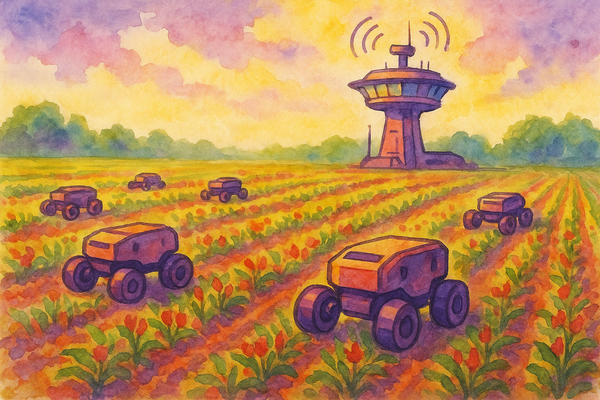
Image generated using ChatGPT
As I have said before, AI is a tool and it should be applied based on the problem you are trying to solve. The starting point should always be the use case. Assuming, you are starting from a use case or problem, what are some of the considerations, when thinking about AI?
I. Sustaining or Disruptive Innovation?
Is the AI powered application or product going to be sustaining within the context or is it going to be disruptive?
A sustaining innovation will strengthen the competitive position of incumbent players, especially in industries where distribution and access to data is controlled by the incumbents. For example, seed companies like Syngenta, and Bayer are sitting on huge amounts of data about agronomic practices on the farm for commodity row crop farmers in the US, Canada, EU, Brazil etc.
Many of the input companies and agriculture retailers and cooperatives, also control complex workflows around agronomic advice and associated sales of input products, and services to the farmer / grower.
In situations where incumbents have a lot of data or are in the center of a complex workflow, it is much harder to have a disruptive innovation compared to a sustaining innovation with AI. Due to this many of the AI led innovations which have to rely on existing data streams or involve working with existing complex workflows, will end up strengthening the competitive position of incumbent players.
For example, AI workflows around agronomic advice, creating prescriptions based on agronomic data will be sustaining innovations which do not fundamentally change the industry structure, but will strengthen the position of existing incumbents. Any AI products and workflows which use LLMs to present insights from existing data in an easy manner will be sustaining innovations, and strengthen the position of incumbents.
As my friend Shane Thomas wrote in “Disrupting agronomy mental models”,
While AI, particularly Large Language Models (LLMs), can automate certain aspects of agronomic recommendations, the technology is more likely to augment rather than fully replace agronomists.” (emphasis by me).
There are other examples of sustaining innovation. For example, the company Brilliant Harvest, which came out of stealth mode recently, is working with equipment dealers. I want to quote from an article written by Shane today.
The system also ingests product manuals (installation, service, repair) enabling farmers, or dealership employees to quickly derive answers to questions about their software or hardware issue for example, saving time.
Brilliant Harvest integrates into equipment dealerships back-end software systems (think CRM, ERP etc), layer on a seamless UX/UI along with LLM capabilities to provide streamlined communication and ambient service environment
The LLM is working with existing data, and will be a sustaining innovation for dealers, and OEMs.
To create a non-sustaining AI innovation, one will have to play with a different set of rules than someone like a Bayer or Deere. Entrepreneurs who want to leverage the latest advances in AI, will have to find data poor and simple workflow environments as they will be more amenable to application of AI.
For example, the current produce buying and selling workflow is not digitized. It is a manual process. If one can digitize the process, they can apply AI to a newly lit part of the supply chain to drive better results.
I would love to hear your thoughts on whether you are working on a disruptive or sustaining innovation.
II. Autopilot or Copilot?
Will your AI solution augment human capabilities to provide insights, suggestions, and tools for decision making (co-pilot) or as an autopilot (fully automating tasks with minimal human intervention)
Our earlier examples of equipment repair user interface or an AI agent which creates prescriptions based on farm level data, are complex high value workflows. Complex high value workflows will typically involve a “human-in-the-loop” and so are more amenable to a co-pilot approach.
The co-pilot approach is great to build trust with the co-pilot and the customer, train staff quickly and efficiently, improve customer service, and drastically reduce issues related to training and churn.
If there are processes which are repetitive, have easier workflows, and are for lower value decisions, an auto-pilot approach can free up time from employees, and help them focus on the high value use case.
The question is not whether a particular process will completely replace humans or not. It is important to break down tasks based on their complexity, repeatability, and the value of each task. For tasks, which are complex, taking a co-pilot approach is better. It also helps protect you from liability. Co-pilot tools create long term value due to enhanced trust from users, consistent performance, and lower operational costs.
For tasks, which are simple, repetitive, and relatively low value, it should be easy (relatively) to completely automate the task using AI. For example, some buyers automate their buying process, including negotiations, if they buy commodity items frequently. Pactum AI has been one of the early startups helping companies like Walmart negotiate without human intervention, till the last step of getting human approval.
At a recent AI conference in San Francisco, I saw demos of digital sales agents, who would make outbound calls, and qualify leads and hand them over to a human agent. The Digital version of the sales agent opens up the top of the funnel, never tires or has a temper tantrum, and is excellent at keeping notes, and learning from the experience.
Is your organization working on AI Autopilot or Copilot concepts?
III. Proprietary of Shared?
Much of field agriculture for commodity row crops is characterized by proprietary data format of different field level operations like planting, harvest, application etc. It is difficult for startups to break in, when much of the data is either locked up or is in proprietary formats.
You are better off if you can create new data. For example, what are the data poor environments in the world today? Smallholder farming data is poorly covered. The challenge here is less on building AI models, but getting data at scale and efficiently. If you can do that, then you can create a stronger AI based company as you will have access to this data easily. If we think about commodity row crops, companies like Deere and Climate have access to huge amounts of proprietary data (though it belongs to the grower).
Some of the freely available satellite imagery like Sentinel 2 is non-proprietary data, though newer satellite data could be proprietary in nature. It is easier for startups to work with open data sources compared to proprietary.
Another approach is for organizations to create proprietary data. For example in biological products, there is dearth of data to support different analysis, and prove the efficacy of the biological product. If a startup can create new data sets, to feed new AI innovations, they can be disruptive, and valuable. Certain markets like smallholder markets (not enough data) would be good targets for some enterprising startups to go ahead and collect a large corpus of data to run AI models.
Is your organization working with proprietary or shared data? I would love to know about your approach and the decision rubric.
IV. Is the early-mover advantage linear or compounding?
With rapid advances in AI, it is a valid question to consider if an early mover-advantage is linear or compounding.
In winner-takes-all models, early mover advantage compounds, if network effects are present. It makes sense to go for an early mover advantage. If your models continue to get better with more and more data, an early lead will be unassailable.
But many of the recent advances in AI have rendered some of the old models obsolete very quickly. Does it make sense to wait for newer more powerful models to come out, and use them to build their use cases? For example, when I worked at Mineral, we spent significant time and money in building ML and AI models using vision systems from scratch. When new vision models were released for object detection, and segmentation, it felt like all the investment we had done, had gone down the drain, as these new models could do many things out of the box, compared to our homegrown ML models.
So should you engage with AI as soon as possible, or wait for the right time to build the right product?
This can be a difficult choice, as it is not clear as to what will be the right time to engage, and how will one know about it.
I am a firm believer in continuous engagement with a promising new technology like AI. The AI models are important but they are just one piece of the puzzle. To build AI models, you need to set up infrastructure capabilities and invest in the management of clean, and actionable data sets, which can feed your AI model.
Even if you do not want to engage with AI right now, one should definitely invest in building technical, business, and human capabilities to work with AI.
Being prepared will give you an edge over organizations which are not prepared and are not engaging with AI. What do you think?
Thanks for reading Software is Feeding the World! Subscribe for free to receive new posts and support my work.