What is NOT changing?
Some things don't change

World Agritech reflections
Last week I had the privilege to attend the World Agritech Summit in San Francisco. It was the first in person public work related event I have attended in more than 2 years. It felt like a coming out party, as I got to see many people for the first time in real life. People were hungry to connect with each other.
The event had an interesting dynamic with the initial few sessions with a panel on stage having a relatively packed audience. As is the case with most events, when you have a large audience, what is said on stage is obvious, and mostly banal. (“We need to solve climate change” - I am assuming there were no climate change deniers, “Food waste is a problem”, “Tech cannot solve ALL problems”, “Solutions looking for a problem don’t work” etc.).
It gave “permission” to attendees to do what they really wanted to do - mingle and connect with others one-on-one or in small group settings.
The IRL setting threw a few surprises, especially on mismatched expectations around how tall someone is in real life vs. what you imagined their height to be. What was not surprising was how people who are kind, engaging, and interesting on video calls, are kind, engaging, and interesting in real life. We can connect well with other human beings on video calls, but we can do it slightly better in real life.
Everytime you go to a conference, there is some new set of buzzwords everyone is talking about. Over the last few years terms like drones, precision agriculture, machine learning, artificial intelligence, big data, platform, regenerative farming, carbon, sustainability, etc. have dominated the conversation. Depending on the year, a few new terms dominate the conversations.
Almost everyone at the conference uses the same language. We all end up sounding the same. (I am totally guilty of doing it, without even realizing it.)
https://twitter.com/timhammerich/status/1507890440485281792?s=20&t=UQN0UpyaO4VK4aSwhspDvQ
What if we took a step back and saw what’s not changing? What is true today, and will continue to be true in the future? What if we design our solutions to address these truths?
What is NOT changing?
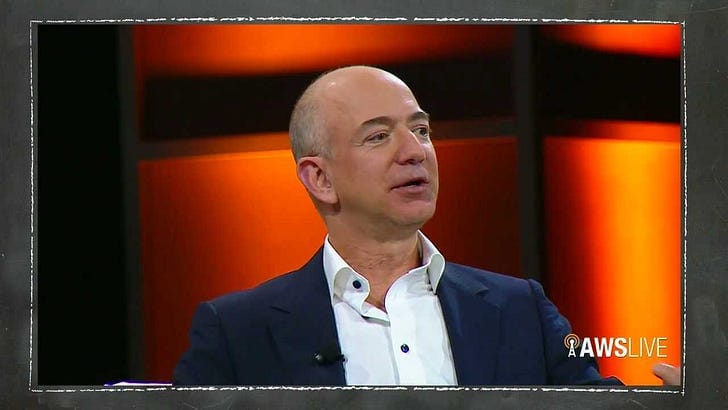
During the 2012 AWS (Amazon Web Services) Re:Invent event, ex-Amazon CEO Jeff Bezos had a conversation with AWS CTO Werner Vogels. Bezos mentioned how everyone is always asking him what’s going to change in the next 10 years, but to him the more interesting question is what is NOT going to change, so that Amazon can design a business strategy around it. He mentioned low prices, large selection, and faster delivery. You should watch the whole video, but the link below starts at the relevant point in the discussion.
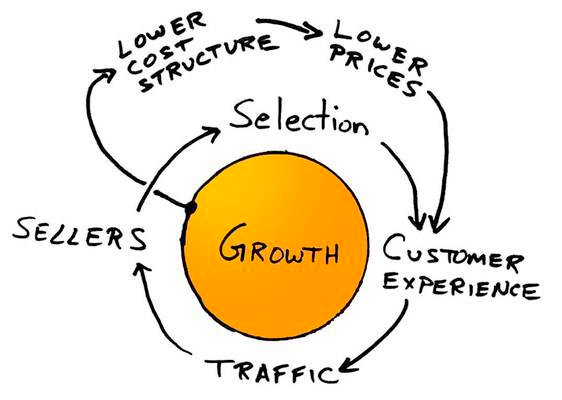
Image source: Benedict Evans
How can we apply the framework of “what will not change” to agriculture, especially broad-acre row crop agriculture? Are there universal truths in the medium to long term? The following are a bit more abstract than low prices, large selection, and fast delivery, and they help point to types of initiatives.
Our desire for easy and pleasant experiences will NOT change
When I worked at Amazon Kindle, one of the problems I worked on was to estimate the number of pages in a digital only book. In a digital only book, the notion of a page breaks down. Amazon would often receive complaints which said “I paid $ 1.99 for this book and it has only 8 pages in the book.” (It mostly happened for self-published books) It was a bad user experience for the consumer, with the potential to create unfavorable brand association. The team anchored around the mental model of a page, which consumers who have ever encountered a book have in their mind.
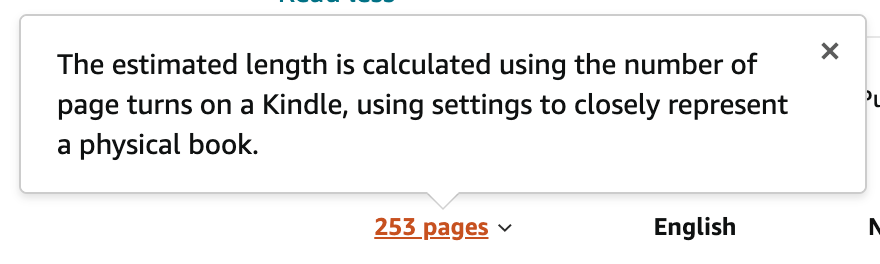
Image from the product page of a digital only book on Amazon.com
I was excited to see, the feature is STILL available with almost the same copy almost 11 years after I was involved in rolling it out to millions of books and consumers.
In the broad scheme of things, the value to readers is fairly small, but it impacts a large number of users. It shows that there is no upper bound to a perfect user experience, as Ben Thompson very elegantly pointed out in his “Divine Discontent: Disruption’s Antidote” essay, and you can always push it further.
From Ben Thompson’s “Divine Discontent: Disruption’s Antidote”
I want to highlight another minor example, which I encountered just a few days ago. My spouse and I were out for lunch at a Chinese restaurant. At the end of the meal, I got a paper receipt to sign after paying by credit card. (Yes, the US is still a bit outdated compared to the EU!) Most paper receipts have a line for you to write down your tip amount, write the total, and then sign. Many paper receipts will include suggested tip amounts and associated totals for different tip percentages. (for example, 15%, 18%, 20% etc.) Almost all receipts make you write down the tip amount, the total, and sign. The credit card receipt at this Chinese restaurant, and had improved the experience marginally, but it had definitely improved it. See if you can spot a slightly improved user experience, compared to what you are used to with paper receipts.
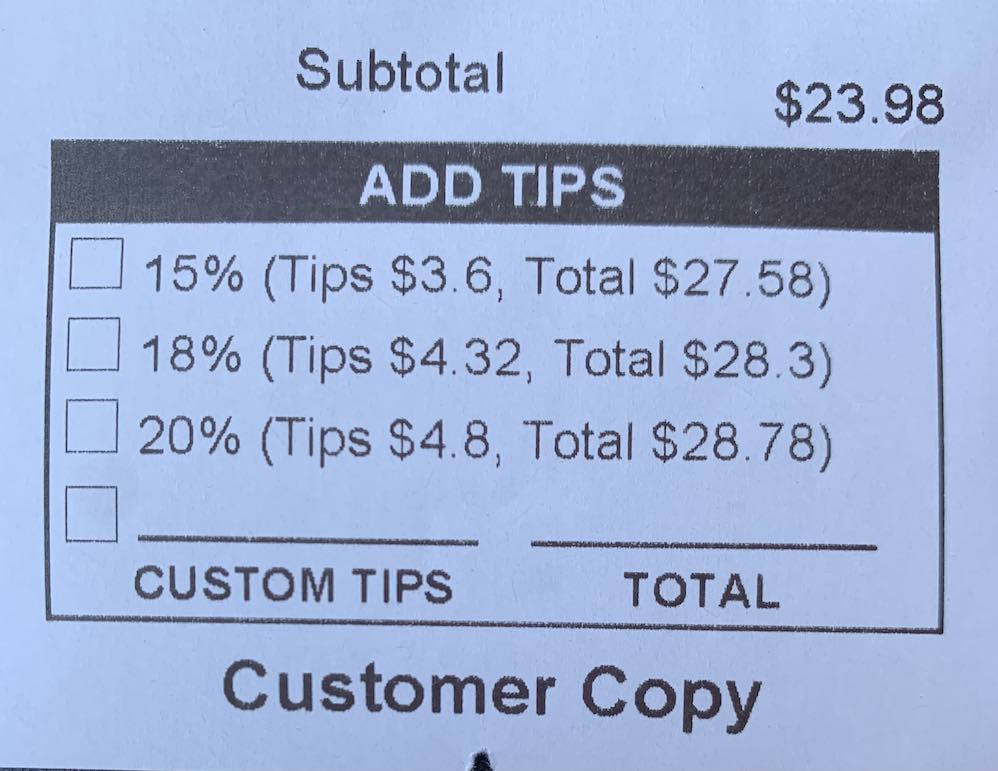
Image by Rhishi Pethe
One of the main barriers to adoption of agtech solutions especially enabled by digital tools like data & machine learning, is that some of the tools are so damn difficult to use or to engage with.
You have to create 3 different accounts, data from one account cannot move to the other account, on boarding needs a complicated setup requiring 37 steps & white-glove hand-holding with a technical expert.
You didn't follow feng-shui principles, while installing the sensor? It won’t work.
Don’t have the internet? It won’t work.
You don’t have on farm data? It won’t work.
If the hurdle to get to initial value from an agtech solution is high, it only brings in the most dedicated and tech forward user onto the solution. Solution providers need to continuously reduce the hurdle to initial value, and meet users where they are. It means exploring easier and better ways to engage with your solution - be it voice, text, and/or a simple onboarding experience for your application. Make sure you have early steps in your value ladder, with the first step being easy to get onto, and the subsequent steps are easy to step up to
Schematic by Rhishi Pethe
A laser focus on time and effort to get to value, and a continuously improving user experience will be a winning strategy even in the long term.
The desire for a better user experience will never go away.
Our desire to lead a stress free life, and spend time with friends and family will NOT change
Most of us want to spend less time working (unless you love what you do) and spend more time with friends and family. Even when we work, almost all of us would prefer low stress compared to high stress.
Farming is a very stressful profession. (I had highlighted some of the mental health challenges through my conversation with Kim Keller of Do More Ag foundation.) Solutions which reduce overall stress, physical, mental, or financial for participants in the food and agriculture systems will find an attentive customer.
Within agriculture, autonomy at various levels and smart equipment have the potential to reduce stress for farm operators. Autonomy will be enabled through path planning, smarter equipment & sensors either in-built into the unit, or retro-fitted to make existing equipment smarter. A combination of sensors, cameras, and on-the-edge computing will make equipment smarter, creating a much better in-cab (or at home) experience for the farm operator/owner
Image source: “Defining the levels of automation” from Farmprogress.com
An example is auto-steer technology, which had one of the fastest adoption rates, due to a significantly improved driver experience, and operational consistency and accuracy.
Our desire for others to understand our point of view & context, and act accordingly will NOT change
It is said that all politics is local. Political candidates and leaders have to understand the local issues and context.
Similar to politics, all agriculture is local. Local conditions affect farming operations, and it is important to understand the context at the farm level. Additional sensors, data, and models will continue to enrich the context on a given farm. One of the key challenges with many agtech solutions today is the difficulty to understand the local context.
The availability of more data through better remote sensing (for example, satellites, radar etc.), combined with on the ground sensors including on equipment etc. will provide a much better context to agronomists, advisors, and growers to make better decisions. As you can see from the image below, it is difficult given the complex interactions and attributes which constitute a given farm’s context.
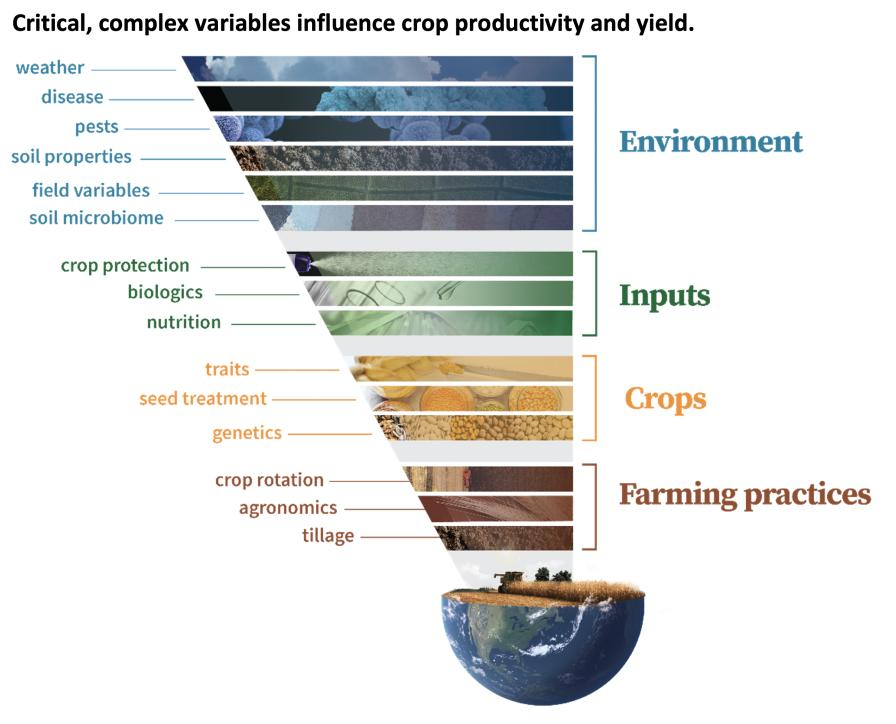
Image source: Why Disciplined Stage Gate Development Process is Critical
Given that agriculture is local, there is always something more the farmer, or an agronomist who has worked with the farmer knows, which a model or data cannot capture. The data, models, and experiences which complement the farmer and/or agronomist’s context & intuition, with rigor and scientific method will create the most value and succeed. The goal of decision support tools is not to always replace the human, but augment human intuition, experience, and expertise with the rigor of data and analysis.
Our desire to do more with less will NOT change
Wanting more from less is a basic human characteristic. We have only 24 hours, but many of us want to squeeze in more within those 24 hours. We want higher yield from the same acre. We want higher yield, without using a lot of fertilizer, if possible. The very definition of productivity is a ratio of output vs. input, and productivity goes up only when output increases at a faster rate compared to the input.
Climate change in the medium to long term, and rising input prices in the short term will propel technologies like see-and-spray, precision inputs, and tailored solutions, enabled by a better understanding of the context.
With diminishing costs of cameras, computing power, and edge computing, technology will help to get more out of less, as we will be able to optimize along multiple dimensions instead of just yield. In the long term, we will be able to tap into the farmland “trapped value”, to create multiple streams of value from farmland.