All I want for Christmas is AI
A look back and look forward on the role of AI in food and agriculture

Programming note:
This will be the last edition for 2024. SFTW will return on January 5th, 2025 with “Last Month in AgriFoodTech - December 2024” edition.
The 15% discount on paid subscriptions is about to expire on December 31, 2024. You will get access to some of the most cutting edge thinking and frameworks around digital agriculture, AI, robotics, etc. and its applications to business models within the agriculture and food systems. You will get access to conversations with industry leaders, how to scale innovations, and the regular weekly analysis on topical issues.
Thank you so much to everyone for your continued support.
Wish you all a Merry Christmas, a very Happy New Year, and Happy Holidays. See you in 2025.
A quick review of 2024 and what can you expect in 2025
As expected, SFTW spent the most time on three topics in 2024: Artificial Intelligence, Robotics / Automation and the Fusion of Digital and Physical worlds, especially in a legacy industry like agriculture. Technology is an enabler for better outcomes. SFTW did deep dives on business models, pricing models, and go-to-market strategies for products enabled by these technologies. As I said in the SFTW Wrapped edition, there are a couple of other experiments I have launched or have been part of.
2024 Experiments
- Launched a paid tier, new features like Scaling Innovation (),SFTWConversationswithinterestingleadersintheAgriFoodspace(), and Last Month in AgriFoodTech (free), added an artist to help with artwork, and launched sponsored editions for the newsletter. (Farmers Edge being the first sponsor).
- Started the AgTech Alchemy community for IRL events and connections with my friends Walt Duflock and Sachi Desai.
- Joined the AgTech Advisory Collective to provide advisory services for the AgriFood industry.
- Dug deeper into ethics and policy issues in technology and AI, with an online class at Stanford for technology practitioners.
- Published a white paper on why AgTech has struggled with adoption and how AI could potentially come to the rescue. The paper was a collaboration with my friends Sarah Nolet and J. Matthew Pryor of Tenacious Ventures.
- Collaborated with my friend Austin Lyons on a piece about labor challenges in agriculture and the role of equipment and automation in solving some of those challenges.
- Guest hosted a couple of podcasts (here, here, here, here) for the Future of Agriculture.
2025 experiments
- Continued focus on AI, automation, robotics, supply chains, ecosystem collaborations, digital & physical fusion, and its impact on emerging business models, pricing models, and go-to-market strategies.
- Exploration of areas like sustainability, input optimization, water issues, smallholder
- More conversations with AgriFood leaders, how they think, and most importantly how they make decisions.
- A series of white papers on the topics mentioned above with two already locked in for the end of January 2025 (On how to build GenAI based products) and early March (how to think about value creation, and capture for GenAI products). If there are specific topics you would love to see white papers on, please reply to this email and we can have a conversation.
- More programming through the AgTech Alchemy group, the AgTech Collective, guest hosting podcasts, and some additional new experiments.
It is fitting to end 2024 with AI and some of its applications in agriculture and food.
Now onto the last edition of 2024.
All I want for Christmas is AI
AI has been the dominant topic across tech in 2024. The whole of 2024 has been a series of “wow” moments within GenAI, as different companies have released amazing update after update, whether it was o1 and o3 reasoning models from openAI, small language models from Microsoft, Google’s Veo2 text to video, NotebookLLM from Google, quantum computing breakthroughs from Google (Willow), and whole host of new capabilities, with massive consumer adoption.
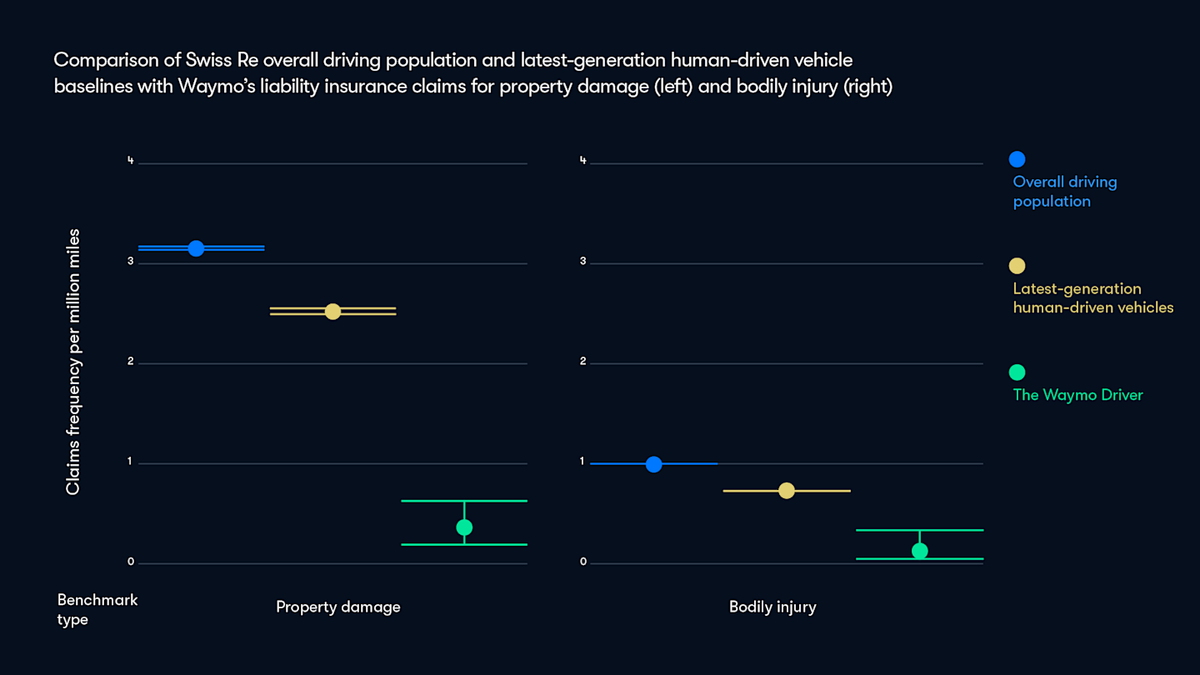
A couple of days ago, Waymo released a study done with global reinsurer SwissRe, which showed that the
Waymo Driver demonstrated better safety performance when compared to human-driven vehicles, with an 88% reduction in property damage claims and 92% reduction in bodily injury claims across 25.3 million miles.
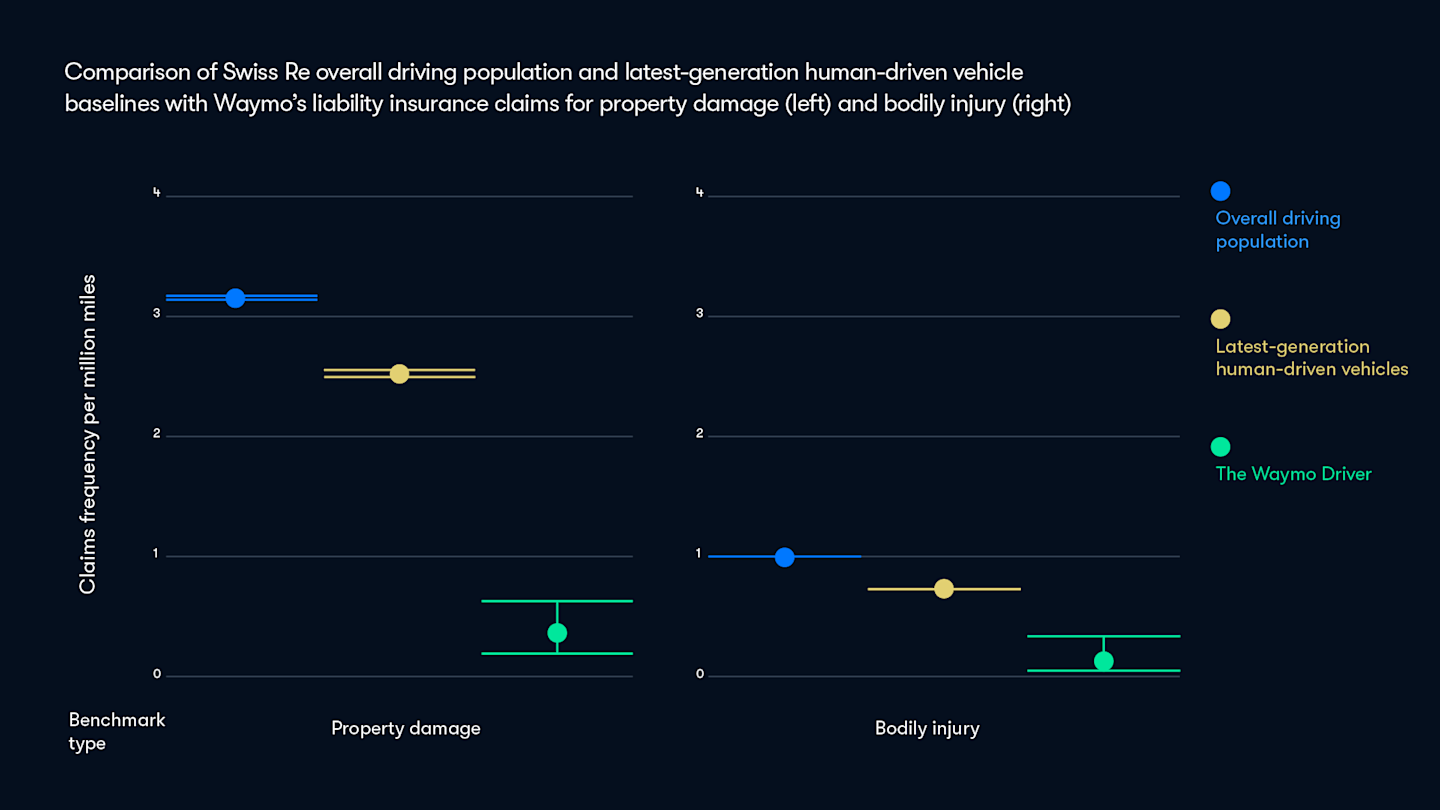
Image source: Waymo-SwissRe study
This is a result worth celebrating as automobile accidents is one of the leading causes of death across the world.
Will human driving be illegal in a few years? Will Rudolf the red nosed reindeer lose his job to a self-driving sleigh?
Maybe not so fast.
Just because technology has advanced rapidly, does not mean industries like agriculture and food get the benefit of these advancements immediately.
Every industry has to evaluate what are the problems they are trying to solve, does the new technology help them solve those problems in a better way, and can they have a sustainable and profitable business model around solving the problem with the new technology.
Every industry has to bring along its users in terms of awareness, and adoption, it needs to have the right infrastructure (things like connectivity), and the right distribution channels for new products based on new technologies to scale and have an impact.
For example, we spent most of 2023 and some of 2024 trying to figure out which are the types of problems which can be solved in a better way using tools like GenAI. When it comes to GenAI, many companies have settled on information management, customer support, and employee training.
We have a strong hypothesis on the value of addressing these problems, but the capabilities and the confidence to roll out these tools to production, with an attractive business model and go-to-market wrapped around it has been lacking. It has not been due to lack of trying.
A very good example is GenAI and LLMs.
The ease of getting started with these models is a double edged sword. It is very easy to build a product which is 80% of the way there in terms of customer expectations of solving a problem, but the last 20% remain quite difficult. In fact, there are way more GenAI / LLM projects, which are stuck in the proof-of-concept or pilot phase, than there are in the production phase (being actually used by customers).
Teams will have to work smarter, and harder to actually get the benefit of these new tools. They will have to obsess over delivering a product which can get to 100%, even if it takes a bit longer and the growth is not as strong as we would like it to be.
There are a few examples of some good products being delivered within food and agriculture in the realm of GenAI, though we will have to wait for additional details on the magnitude of impact and value created.
Bayer’s E.L.Y
A few weeks ago, Bayer Crop Science released a small language model specifically targeted towards the use of crop protection products.
Using a crop protection product requires an understanding of the label information provided by the crop protection product’s input manufacturer. The label typically has to follow a structure and format provided by the EPA (in the US). If any of you have seen a crop protection label before, it is complicated and has a ton of information which needs to be considered before using the product. It is not surprising that context is very important.
Here is an example of a label for “Warrant Herbicide” from Bayer. If you look at just one subsection of the use restrictions section of the label, it requires understanding the soil type, presence of ground water and its distance from the surface, distance from wells, etc.
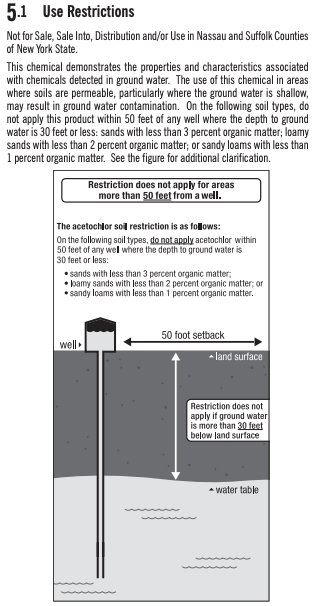
This is complicated stuff and it is challenging for front line staff to be able to have all of this information at their fingertips across a wide variety of products and a wide variety of contexts.
A GenAI model which can ingest all of the label data, and then accurately provide information back to the user based on natural language queries, would be hugely valuable in terms of time savings, responsiveness, accuracy, and a higher level of customer service. Bayer has done a good job of identifying a problem, and then applying a tool which can solve the problem in a better way than currently available methods.
E.L.Y. is a small language model specifically targeted towards the use of crop protection products.
Continuously validated by Bayer agronomists, E.L.Y. is already enhancing productivity for over 1,500 frontline employees in the United States. These employees are leveraging the model to navigate complex agronomic information, delivering faster and more accurate results to farmers and other agricultural customers seeking insights about Bayer products and general agricultural practices. Focus group testing indicates that 90 percent of E.L.Y.'s users are willing to continue using it and recommend it to a colleague.
It has been trained using Bayer data, agriculture extension data (which is oftentimes widely available but someone has to put it all together), open source data and any other data sets like product catalogs which include product usage information are included in the training set for E.L.Y.
E.L.Y has information about pests, rates of usage (very important for crop protection products), and it also is able to consider product safety and liability information.
Based on data from frontline employees like agronomists, and sales staff, Bayer has achieved over a 40% improvement in answering questions accurately compared to initial testing with ChatGPT.
Frontline employees report time savings of up to four hours per week, demonstrating how E.L.Y. has accelerated response times and improved customer interactions. To ensure high accuracy, the team has implemented automated processes to keep the system updated with the latest agricultural information.
Syngenta’s Cropwise AI
Syngenta has launched a seed selection assistant within their Cropwise AI application, which includes consideration of multiple factors like seed product characteristics, growing context, and the farmer specific needs and goals. This tool is used by Syngenta sales representations to assist with their interactions with customers to help them do a better job of positioning Syngenta brand seeds.
Each of these input companies have a large portfolio of seed and crop protection products. It is challenging for front line sales staff to stay up to date on all products, and answer all the questions a grower might have in real time.
The issue of churn in sales representatives is also a challenge due to onboarding and training needs for new employees. The Cropwise AI agent can address some of these challenges and make the sales representations more effective.
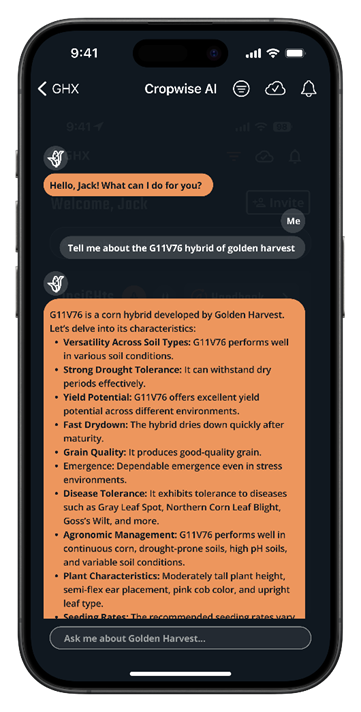
The implementation of Cropwise AI has yielded significant improvements in the efficiency and accuracy of agricultural product recommendations:
- Sales representatives are now able to generate recommendations with analytical models five times faster, allowing them to focus more time on building relationships with customers and exploring new opportunities
- The natural language interface simplifies interactions, reducing the learning curve for new users and minimizing the need for extensive training
- The agent’s ability to track recommendation outcomes provides valuable insights into customer preferences and helps to improve personalization over time
Syngenta evaluated the results based on a dataset of 100 Q&A pairs from sales representatives and ran them against Cropwise AI. The following graph shows the results of this evaluation which indicate that the provided answer relevancy, conciseness, and faithfulness are very high.
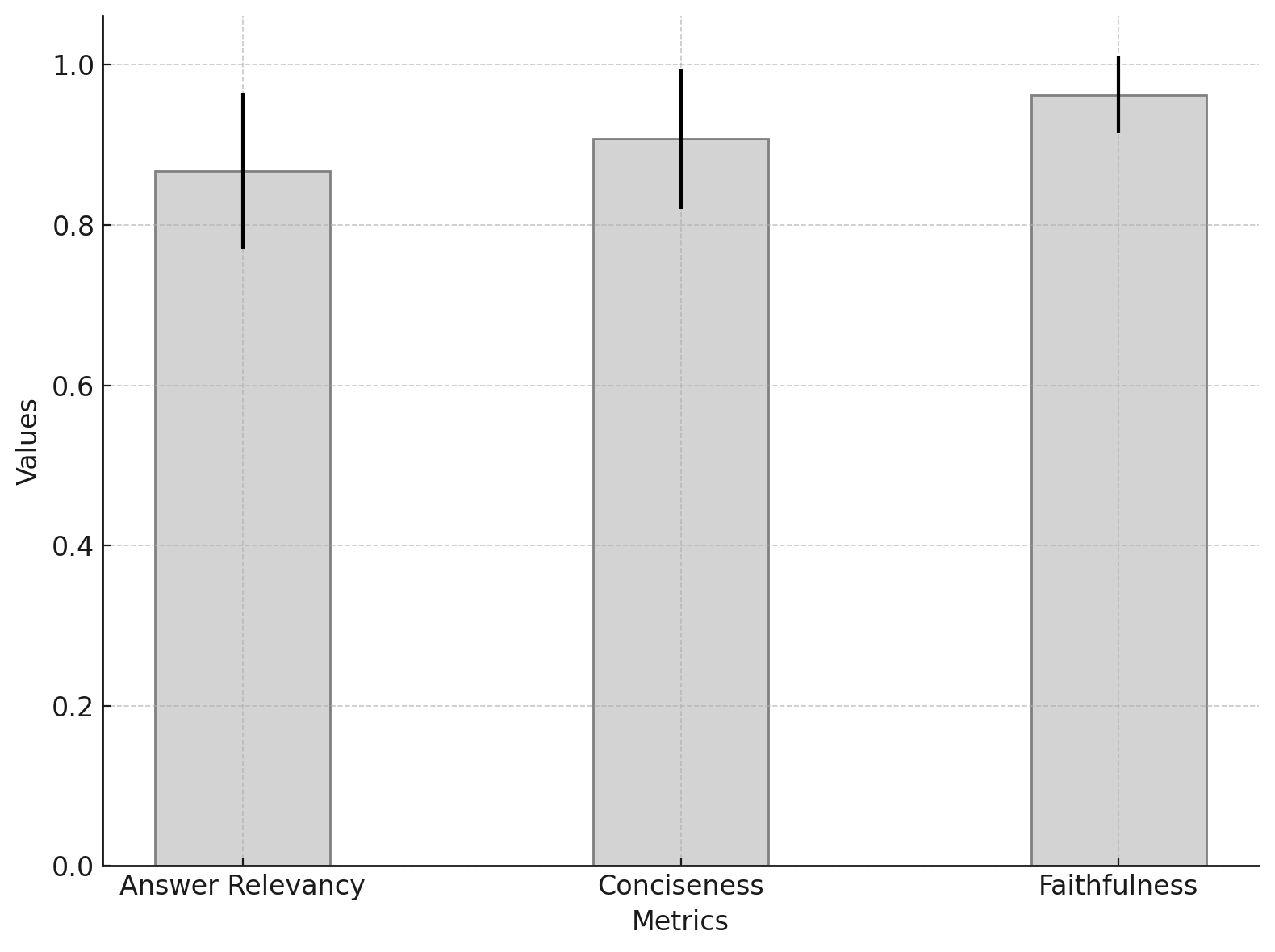
To read what Syngenta’s CIO thinks about AI and its possibilities, please read my conversation with Feroz Sheikh.
Digital Green brings GenAI powered extension services to smallholder farmers at a much lower cost
The concept of Small Language Models and the use of different architectures like RAG (Retrieval Augmented Generation), powered by a context aware large data set of agronomy data has enabled Digital Green to provide extension services at a much lower cost per farmer and new practice adoption. Digital Green’s Farmer.Chat is having a real and measurable impact on entrepreneurs, extension agents, and farmers in Asia and Africa. Please do read this inspiring story to see how technology applied properly can have a big impact.
By leveraging the capabilities of Farmer.Chat Kenya, an AI-powered digital assistant designed specifically for farmers, Annred has not only revolutionized her farm operations but has also become a source of inspiration and leadership within her community.
Buoyed by this success, Annred expanded her agricultural endeavors. Initially focusing solely on millet, she diversified her crops to include maize, beans, bananas, sunflowers, and even ventured into poultry farming. Each step of the way, Farmer.Chat provided her with tailored advice that maximized her yields and minimized costs. The digital tool helped her understand the best planting practices and optimal harvest times, significantly boosting her farm’s productivity.
GenAI used to improve productivity with some unintended (?) consequences
Angular Ventures recently provided this perspective based on what they are seeing in the market.
Many of these products are priced and bought as a replacement for employees. AI products are increasingly speaking in the language of “agentic augmentation” of employees. If the tool makes employees in a given function 10-90% more effective, it can easily be argued that it allows the customer to avoid hiring and training at least one employee.
The starting price for a lot of these tools begins around $100K and is seen as the equivalent of an entry-level employee. The economic buyer (which can be anyone with hiring authority in the organization) faces a simple choice: they can hire yet another human employee or they can buy an AI product which will enhance the entire team, reduce their management and training burden, and put them on the cutting edge of technology making them a hero in the organization to senior management which is eager to talk about AI.
The choice is an easy one for most - and thus the sales surface area for these AI-first tools is simply enormous.”
Any technology is often a double edge sword.
While the first few stories are about the potentially positive outcomes of GenAI, this current story from the Philippines (not an ag story) shows how the technology can create undesirable outcomes for certain people.
AI is reshaping call center work in the Philippines, which is one of the largest employers of call center employees in the world (1.84 million BPO employees). A company called Concentrix uses AI to check and “assist” every employee through the use of AI co-pilot.
The advanced AI tool uses language and emotion recognition in combination with GenAI to make work more demanding.
It scores the call center employee on their tone, pitch, mood of the call, their use of positive language, and nudges them towards higher scoring responses like “yes”, “perfect”, and “great”. Every stutter, pause, mispronounced word, or deviation from script gives them negative points.
According to one estimate, about 300K workers in the call center industry could be out of their jobs in the Philippines in the near future.
The same technology is being put to surplus creating products by my friend Varun Puri’s company Yoodli. Yoodli is a communications coach to help employees do a better job in their presentations, which are a critical part of success in our professional and personal lives.
Automation and Autonomy makes a push
Autonomy has been powered by a convergence of many technologies like vision systems, edge processing capabilities, LIDARs, other sensors, and the integration of artificial intelligence into these models.
Startups like Sabanto in commodity row crops, GUSS automation in tree crops, Aigen Robotics, and many others have pushed forward with autonomy or human-assist products at different price points and business models over the last few years.
The rising labor costs in California in particular, and the US in general, and the significant immigration related issues are tailwinds for robotics in general, and autonomy in particular.
There are more than 1200 crop robotics startups out there right now. Crop robotics is a huge area powered by better and cheaper cameras, more performant processing power at lower price, and significant advancement in AI modeling architecture and models.
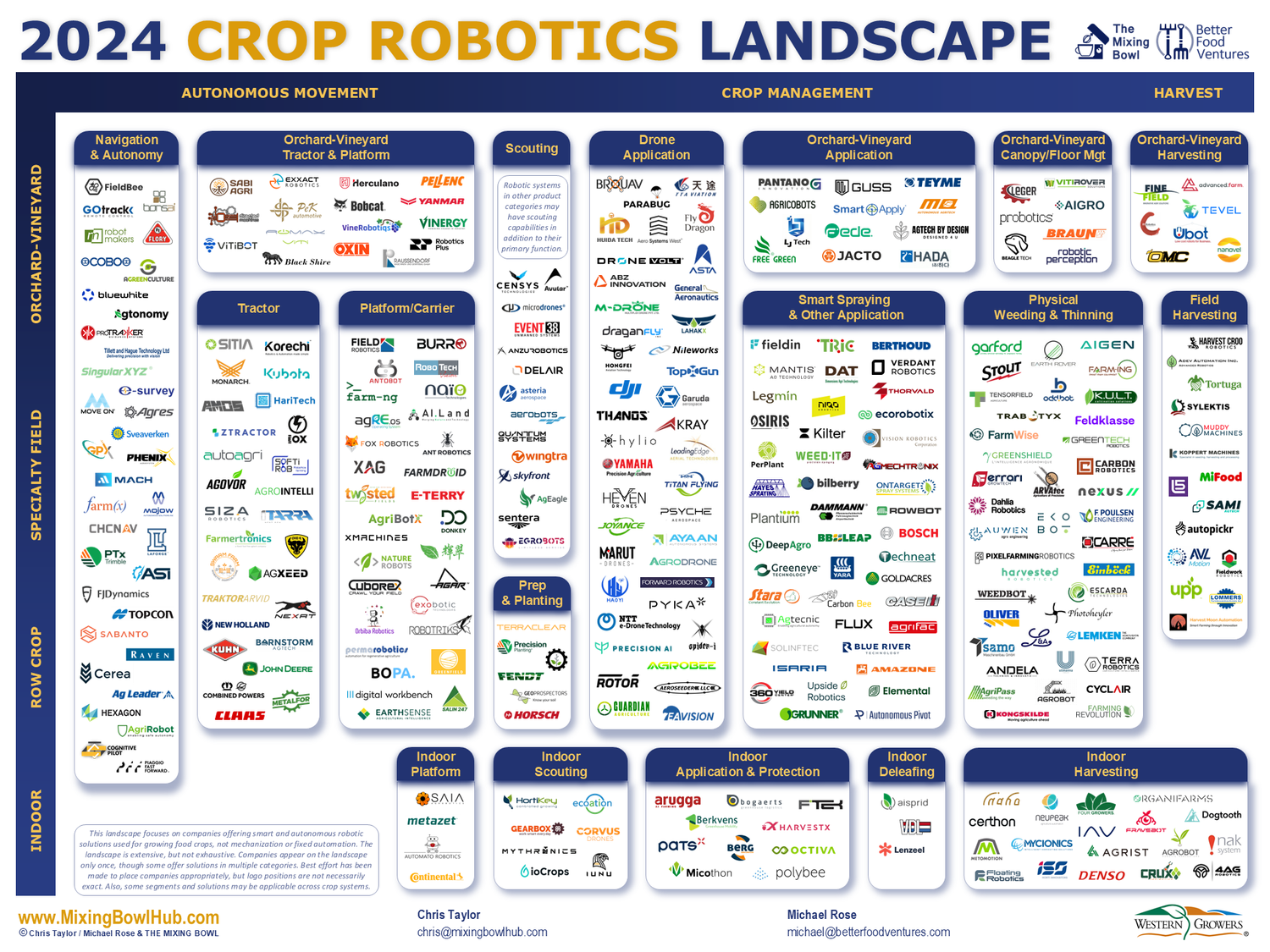
Source: The Mixing Bowl, 2024
Monarch struggles with autonomy and electrification
Monarch has been one of the early pioneers, when it comes to low to mid horsepower robotic tractors. Monarch though has struggled with making the unit economics work and has struggled to focus on one particular area.
As I mentioned in edition 164. Survive till twenty five, the only reason Monarch’s current business model works is due to the high subsidies available for electric vehicles.
The business model for Monarch is challenging. The high investment has to pay off for VCs, OEMs like Monarch, service providers, and end users - farmers. As I discussed during the FarmWise Scaling Innovation edition, many robotics companies have switched to selling their equipment to farmers instead of providing it as a service for critical and expensive pieces of equipment with a price tag of $ 1.4 million.
By taking an assumption of 210 hours per tractor, the average farm labor rate of $ 19 / hour in California, and the current diesel price of $ 4.80 per gallon, the calculator gives operational savings of $ 5,308 per year. If diesel and labor are cheaper, then the business case for Monarch becomes weaker.
The savings are not trivial, but with a sticker price of $ 89,000 per tractor, savings of $ 5,300 / year will be tough to sell.
On the other hand, Burro’s harvest assist robots have seen much more success as they focus on a specific task instead of full autonomy, and try to take out costs and show ROI immediately to the farmer.
Deere announces fully autonomous and electric tractor (75-100HP) by 2026
Deere has made its intentions clear.
It is going for both autonomy and electrification. Given the battery challenges for a higher HP machine, Deere is targeting the 75-100 HP tractors and are committed to a fully autonomous fully electric tractor by 2026. They plan to do hybrid models above the 100 HP range, which makes sense, given battery size and weight requirements above 100 HP.
Deanna Kovar, President of John Deere’s Worldwide Agriculture & Turf Division for Europe, Asia, and Africa, recently shared Deere’s future strategy.
In terms of fuel, our strategy is clear. We are electrifying our products up to a certain size and have already committed to a fully autonomous, fully electric tractor of 75-100 horsepower by 2026. For larger machines, we are investing in hybrid technology. We believe agriculture can contribute to tackling CO2 challenges with biofuels.
We are also fully open to collaboration with other companies, for example, through compatibility with Isobus and data systems. While we promote the advantages of combining John Deere implements with John Deere tractors, we must acknowledge that mixed-brand fleets are a reality—especially in Europe. The John Deere Operations Center, the most open digital farming platform in the world, has over 250 connected software companies. This openness continues to drive our digital strategy.
The interesting part of Ms. Kovar’s comments were about collaboration with other companies around machinery data exchange protocols like ISOBUS and the associated data systems. Deere is using the example of the ops center as evidence about their open strategy, though for mixed brand equipment to work together in a farming operation, it will require cooperation at the machine data protocol level (ISOBUS, CANBUS etc.).
Deere is committed to reach a fully autonomous farming system by 2030.
Product development
AI has been used in product development for quite some time now. The AgBioInvestor report from the beginning of 2024, showed the cost and time to bring a new herbicide or any other type of chemical molecule to market as an effective product has gone up significantly.
Techniques like AI and Deep Learning are making product development processes for input companies much more targeted and hopefully efficient in the long run. We don’t have enough data to make the conclusion, but it is again an exciting new set of tools to solve a gnarly problem.
AI for herbicide discovery
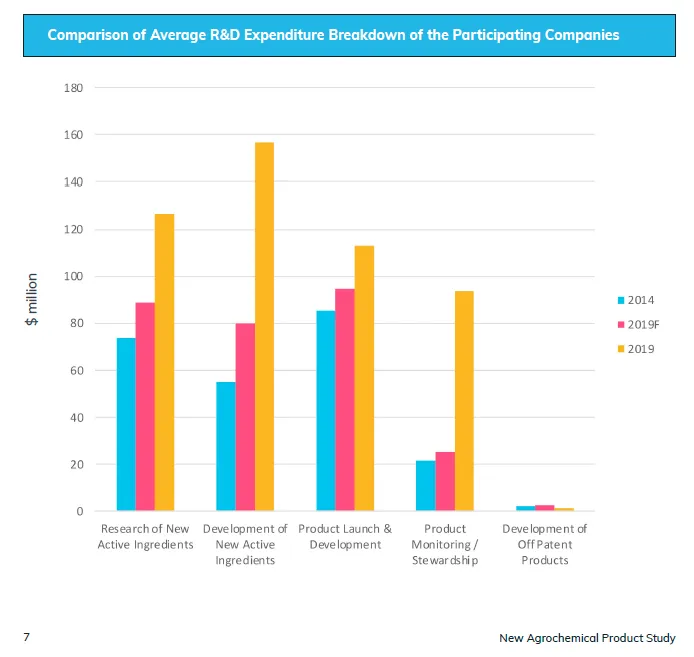
Due to computational advances, AI can widen the top of the funnel and look at a much larger set of molecules to start the search process. Some companies can look through a few billion molecules very quickly to whittle down the list of potential candidates.
Expanding the funnel at the top might sound counterintuitive, but with the use of AI, it increases the chances of finding a candidate, which a less exhaustive search will miss.
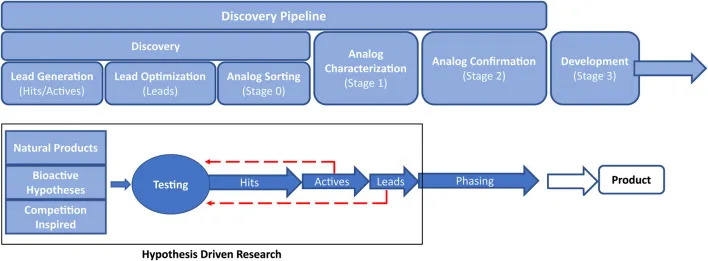
Herbicide discovery pipeline process. Image source: Cheminformatics and artificial intelligence for accelerating agrochemical discovery.
There are many principles used in drug discovery which are applicable to herbicide discovery. For example, the sophisticated protein modeling platform AlphaFold, can dramatically narrow the search space, by predicting the 3D structures of plant proteins which are involved in essential biological pathways in weeds.
Deep learning models trained on large datasets can help predict how well a molecule will bind to its target, how will the molecule design have an impact on selecting the right target and for safety, how can it potentially overcome resistance, and how will it interact with other variables through a data driven approach.
AI for ingredient substitution and food formulation
GenAI is being used for product development in identifying food ingredient substitutes. For example, startup Agilitas has launched a GenAI powered platform to accelerate product formulation by up to 100X, especially in the case of ingredient substitutions.
Agilitas uses off-the-shelf LLMs and combines them with proprietary ingredient and formula data sets. The current formulation process in the industry is outdated, relying on legacy technologies that fail to meet modern needs. With Agilitas, AI becomes an indispensable tool, turning complex workflows into streamlined, data-driven processes.
AI for snack recipes and taste profiling
A new AI based tool developed by Mondelez is speeding up the creation of snack recipes and optimizing them to fit certain taste profiles. Which means less lab work, faster time to production and—for better or worse—fewer in-house tastings.
The point is we get there faster,” Wallenstein said. “The consumer wants the product to taste like X. We’re not stopping iterating until it tastes like X … we’re doing things more efficiently.
Food companies like Mondelez are racing to try out AI in every area of their business, from supply chains to marketing to recipe development,
Many other areas within the food and agriculture value chain already use AI to make better decisions, and there are too many to list them here.
Challenges still remain
If you spend your time on X, or any other form of social media, you would not be wrong to think AI’s impact is being widely felt in our day to day lives. It is definitely having an impact on your stock portfolio or 401K accounts (here in the US) as the stocks of many of the AI companies and hyperscalers have soared over the last few years.
Beyond the use of ChatGPT to do research, most of us have not seen a visible impact of AI within our lives yet, though it is there. (See Google Maps, or Uber, or Amazon shipping things to you, etc.)
Just like with any new technology, significant challenges still remain when it comes to commercialization and scaling of AI based products. They are not very different from any other new technology adoption in the past.
- Evolving, sustainable, and profitable business models
- Data challenges
- Infrastructure issues
- Skill set, training and awareness amongst employees, and customers
- Understanding of technological maturity
- Evaluation of legal, public relation, and policy risks
We will cover many of these issues in more detail in 2025.
For now, I just want to wish you a Merry Christmas and Happy Holidays.
You can still sing “Rudolf the red nose reindeer…”, though all I want for Christmas is AI