IoT in agriculture
Connectivity is the key unlock

Welcome to the first “Closer Look” edition of Software is Feeding the World. This will be a monthly edition on the second Wednesday of every month to take a closer look at a particular issue. This month’s edition is focused on infrastructure (one of my favorite topics) around IoT, connectivity, and low-powered sensors within agriculture.
I Nano Ganesh
A couple of years ago, I saw a product called Nano-Ganesh in India. (Ganesh is the Hindu elephant-god, who is always invoked at the beginning of any project for success). Nano-Ganesh is an IoT device used for irrigation control by farmers using mobile phones. The farmer can turn their pump on or off, by sending an SMS message to the device.
It is dangerous for farmers to walk through snake-infested fields at night to operate their irrigation pump. The use case is for farmer safety, efficient and timely use of water, and better yields.
II How do we get data about the farm?
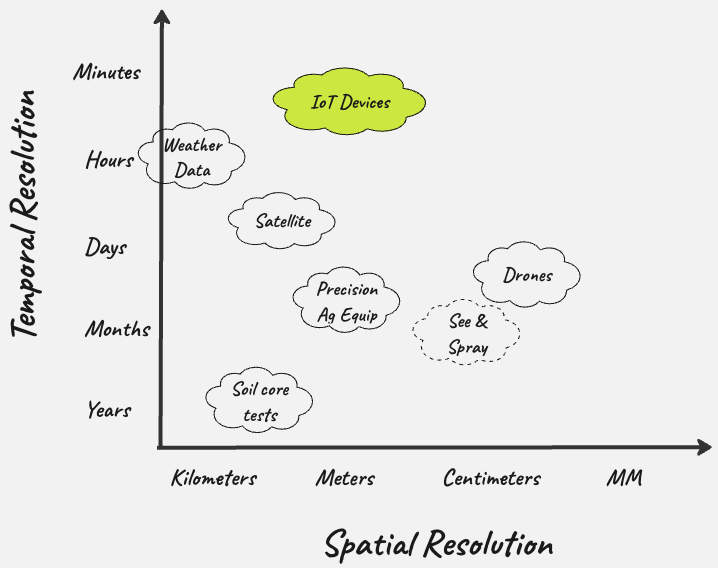
There are many devices and tools to capture farm level data. The captured data varies quite a bit based on the temporal and spatial resolution.
For example, weather data can have a spatial resolution of a few kilometers, but might be recorded every few hours.
A satellite high up in the sky could record data at a higher spatial resolution (for example, 10m x 10m pixels on Sentinel 2), but a lower temporal resolution based on the revisit rate of the satellite.
Soil core samples are taken every few years, and one sample is often taken for a large number of acres.
Drones with high resolution cameras can record very high spatial resolution data. The temporal resolution will depend on the frequency of drone flights.
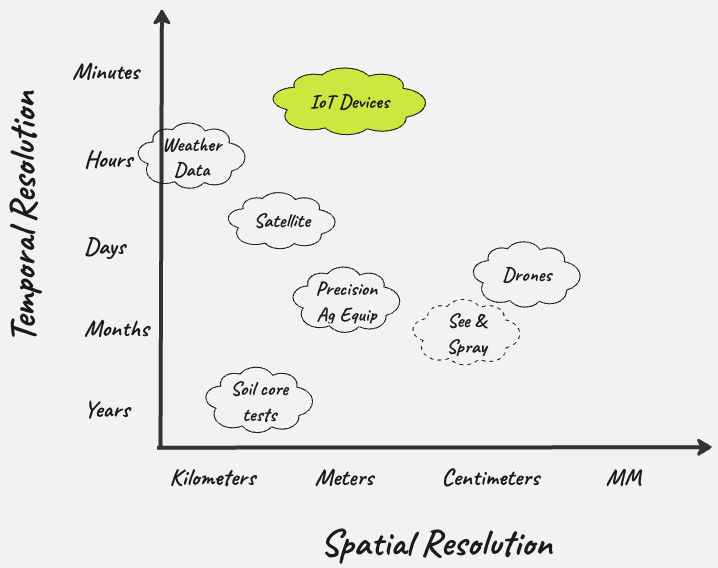
Chart by Rhishi Pethe
There is space for IoT devices to capture data at a higher temporal resolution, and a reasonable spatial resolution to provide real time updates on different attributes like soil moisture levels, liquid levels in tanks, livestock location, presence of pests in an area etc.
Every farm is a microcosm of our universe with its own microclimate, soils, topography, history, and which impacts agricultural outcomes.
For example, a soil moisture device could send a very small payload of soil moisture data every few minutes / hours, and piggy back on the local network through a protocol like LoRa. The spatial resolution can depend on how many soil moisture probes are installed per unit area in the field.
A network of IoT devices which monitor different attributes can provide timely signals. When this data is combined with other data, it can lead to more precise and real time decisions. These devices can plug into a low-cost network to provide timely signals about different attributes. The same network can then be used to take action, through two way communications.
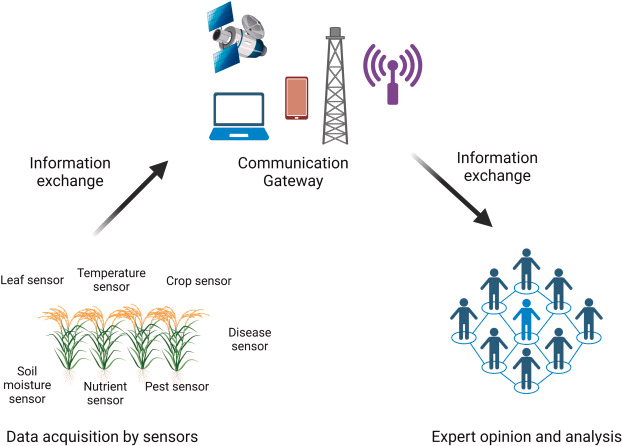
Data flow for IoT devices and connectivity to a network for analysis and decision making Source: Prem Rajak, Abhratanu Ganguly, Satadal Adhikary, Suchandra Bhattacharya, Internet of Things and smart sensors in agriculture: Scopes and challenges, Journal of Agriculture and Food Research, Volume 14, 2023, 100776, ISSN 2666-1543, https://doi.org/10.1016/j.jafr.2023.100776.
Different IoT sensors can optimize operations and production through the measurement of soil moisture, temperature changes, humidity, soil properties, and precipitation. IoT devices can be applied to livestock to assess their reproduction, health. They can be used inside supply chain assets like grain bins, truck containers, cold chain infrastructure etc.
There are a variety of IoT devices which use various technologies such as GPS, sensors, equipment, and software and help farm operators keep track of different variables in real time, and make informed and timely decisions remotely.
It has the benefit of being proactive, can increase quality and yield, reduce inputs, optimize time and labor requirements, and ultimately boost profitability and sustainability.
III Connectivity is the big challenge
If there are so many potential benefits, why have we not seen a significant adoption of IoT devices. There are quite a few challenges which exist for adoption of IoT devices.
One of the biggest hurdles to IoT adoption is the lack of robust low cost internet infrastructure. Strong internet service is imperative for real-time data transmission. Complex terrain, poor internet infrastructure, and increased exposure of IoT devices to severe weather conditions disrupt the data flow.
According to the Food and Agriculture Organization of the United Nations, less than 33% of the world’s surface has mobile network coverage, and most of the coverage is in high populated urban areas.
For example, it might be interesting to get ear tags for cattle, but if the costs to backhaul the data captured by the ear tag (location, maybe some health attribute) are in the 10s or 100s of dollars, then there is not enough value to support the investment in the low-cost ear tag.
According to a report by McKinsey, agriculture connectivity could unlock more than $ 500 billion in GDP by 2030.
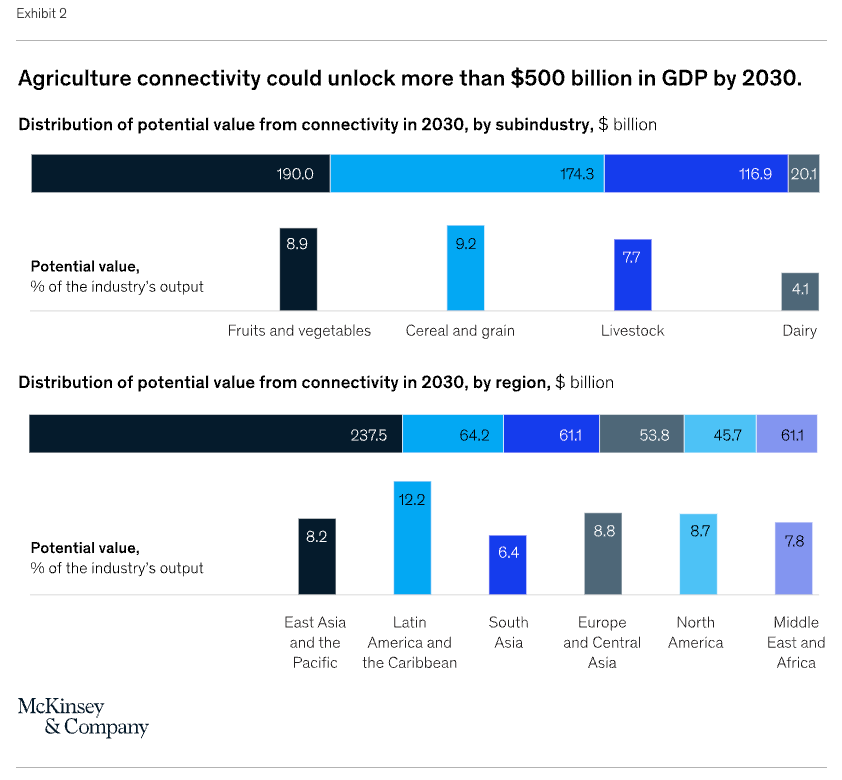
Image source: Agriculture’s Connected Future and How Technology Can Yield New Growth, McKinsey
Data from the USDA’s Economic Research Service indicates that farming contributes to nearly $133 billion of our country’s gross domestic product. Based on USB’s rural broadband survey, the lack of connectivity negatively impacts farmers responsible for $80 billion of gross domestic product.
OEMs like Deere and CNH have invested in connectivity to get the maximum value from their farm machinery. OEM connectivity efforts are targeted towards machine-to-machine coordination and machine performance management. With connectivity, farmers facing rural connectivity challenges can benefit from precision agriculture.
“The value of connectivity to farmers is broader than any single task or action. Connectivity unlocks vast opportunities that were previously limited or unavailable”
For example, Deere has pushed for a SATCOM solution which uses SpaceX’s Starlink satellite constellation. This solution is not inexpensive, as John Deere dealers have to install a Starlink terminal on compatible John Deere machines to connect it to the JD Ops center. This can run into hundreds and thousands of dollars.
CNH has partnered with Intelsat with their constellation of LEO (Low Earth Orbit) and geosynchronous satellites to provide CNH brand customers satellite coverage using industrial grease terminals. This can also run into thousands of dollars.
There are different types of connectivity technologies available, with different pros and cons. Connectivity is not a one-size fits all and agriculture will often need a combination of different connectivity protocols to get the full value of the data coming from their operations and the supply chain.
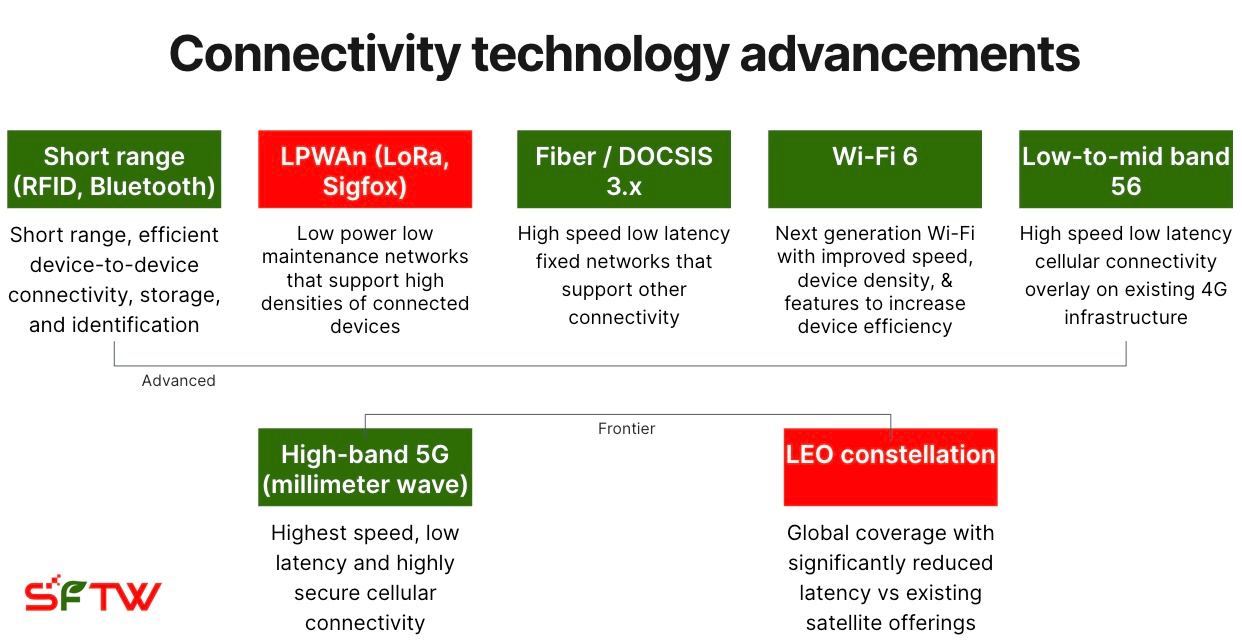
Data source: Agriculture’s Connected Future and How Technology Can Yield New Growth, McKinsey
For example, both CNH and Deere are partnering with Intelsat and SpaceX to get access to global coverage through each of the company’s LEO and GEO constellations.
There are other technologies like LoRa available, which can send and receive very small packets of data at very very large distances, the IoT devices connecting with them are relatively inexpensive and have large useful lives (~5-10 years).
Before we dig into the details of LoRa technologies, let us look at the types of IoT devices / sensors available today, and what are the different use cases associated with each type of sensor.
Other challenges include a positive ROI on the investment (which is a challenge due to costs), high upfront and operational costs, and data security and privacy issues.
IV Types of IoT devices and use cases
Sensors are becoming smaller and cost-effective to make the technology more accessible. As data analytics techniques keep advancing, IoT devices will be able to create more value, aiding farmers in yield prediction, disease and weed detection, and optimized resource use.
The table below summarizes the different types of sensors already available at the farm level to monitor different attributes
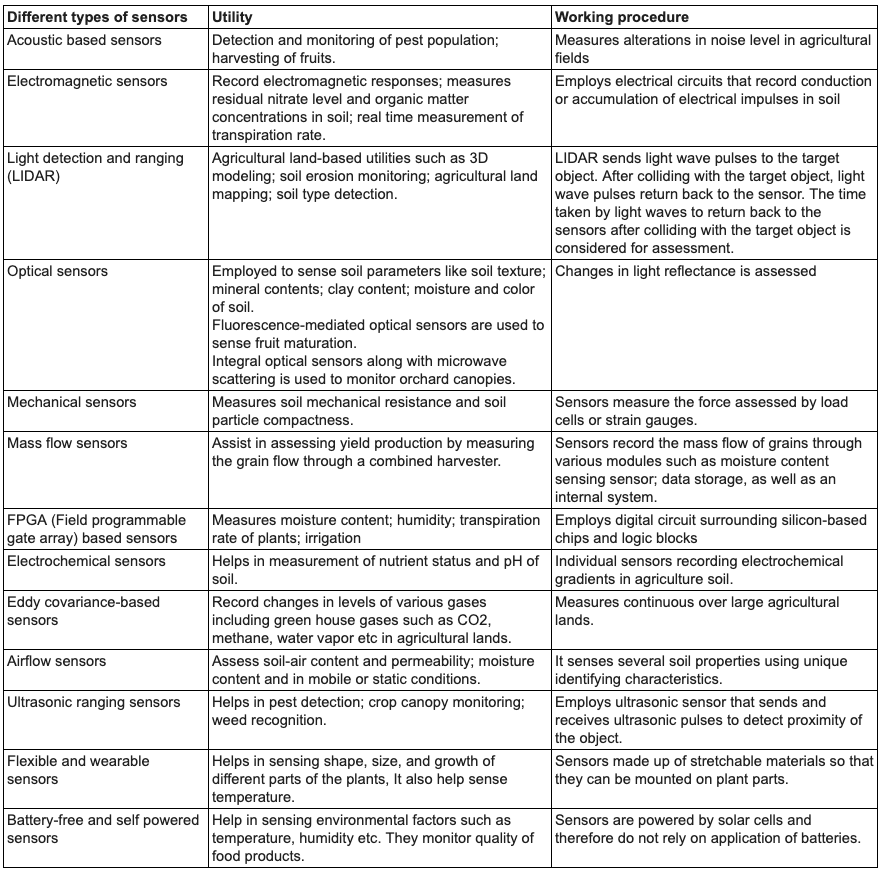
Type of IoT devices and their utility
V What will create dense IoT networks?
The adoption of IoT in agriculture is fraught with challenges that stem from the very nature of farming environments and the technology itself. Connectivity issues are a concern, as many farms are situated in rural areas where internet access is limited or unreliable.
In an effort to capture, understand, and address field variability, we can use inexpensive sensors that are easy to install and maintain scattered throughout an area. These sensors will communicate back to a more advanced sensor that serves as a central hub. Then, either through edge computing, where data is processed inside the central hub, or by analysis in the cloud, a more complete picture of the field will be created. Decisions can also be transmitted back to the sensor to take a particular action (for example, turn off irrigation, if the soil moisture goes above some threshold).
For sensors, which have to stay out in the open for long periods of time, the sensor has to be able to transmit and receive data without charging for long periods of time (often years). It should be inexpensive. It should be able to work in a hostile environment. It should be able to transmit data to the nearest internet gateway, which could be quite a distance depending on the density of the connectivity network.
Technologies like LoRa and Sigfox are ideal for low-cost IoT devices due to their low-power, low-maintenance characteristics, while being able to send data over long ranges.
For long-range communication, LoRa (Long Range!!) is patented for chirp spread spectrum modulation scheme (CSS) which was developed in the 1940s. CSS has been used in space communication and military due to its robustness to interference and long communication distances. LoRa can meet many of the requirements, which we had laid out before. It does need access to a network of LoRaWan receivers.
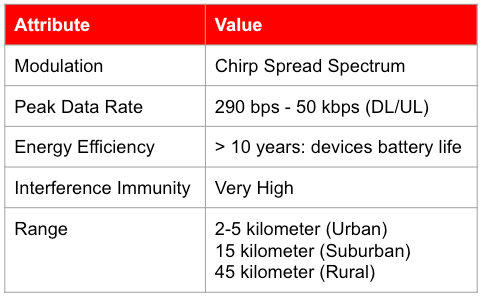
Source: /content/files/wp-content/uploads/2020/02/giis2019.pdf
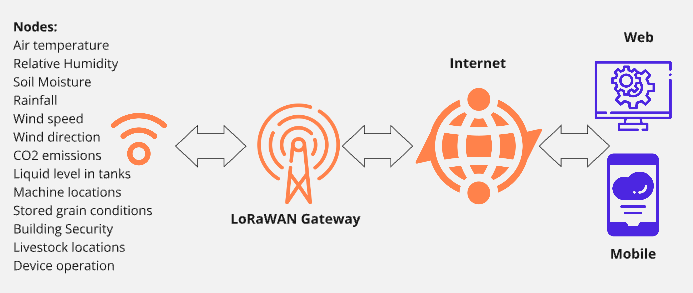
The nodes can be small and battery-operated sensor devices, and installed in remote locations. The gateway communicates with the nodes, receiving data from the sensor devices and transmitting signals back to the sensor devices so they can be managed remotely. The LoRaWAN gateway also functions to move the data to the internet so it can be viewed by the user.
VI Final Thoughts
The future of IoT-enabled smart farming looks bright as technologies continue to evolve. Sensors are growing smaller and cost-effective, making the technology more accessible.
As data analytics techniques keep advancing, IoT will be able to create more value by aiding farmers in yield prediction, disease and weed detection, optimized resource use, and through new use cases throughout the food and agriculture supply chain.
Network connectivity is the key unlock needed, which requires infrastructure investments, which could be a slow burn. The drop in upfront and ongoing operational costs for farmers is critical.
If we want to see a real example at a massive scale, the rate per 1GB data has been declining for years in India. 2016 was a bellwether year, when Reliance JIO (a leading telecom operator and a conglomerate in India and family with the big expensive wedding) introduced low cost plans. In the chart below, the cost of 1 GB of data at the end of 2021 was Rs 6.6 (or roughly US$ 0.09 per GB). The cost of mobile data in the US was about US$ 2.80 per GB in 2023.

Source: Reliance Jio’s cheap data turned India’s internet dreams into reality
The rate of mobile data usage shot up in India in the last 7-8 years by almost 300 fold and the number of mobile data users have climbed to almost a billion people. The low cost of data enabled a plethora of use cases, which were not accessible before. For example, the number of digital payment transactions went from 1 million in 2016 to 10 billion transactions in 2022 (10,000 times increase in 6 years!!), with India accounting for 46% of the worldwide digital payment transactions in 2022.
Technology is traditionally deflationary in nature. Technology is not adopted at scale because it is cool, but it is adopted because it is a much better way to solve a problem and in time at a much lower cost. For IoT technologies to scale, and to unlock new use cases, investments in connectivity infrastructure will be absolutely essential and necessary.