SFTW Convo: Managed services with Vibhore Arora
Conversation with the CEO of Farmers Edge.

Welcome to another edition of “SFTW Convos” with Vibhore Arora, CEO of Farmers Edge.
Farmers Edge has been a trailblazer in AgTech, recognized as one of the early pioneers in Canada. Over the years, the company has undergone a significant evolution, adapting to the needs of agriculture. In 2022, Farmers Edge saw senior management changes, bringing on an ex-Amazon executive, Vibhore Arora, to lead the company in a new direction. Under Vibhore’s leadership, Farmers Edge has taken on a new strategy, focused on delivering Managed Services to better serve agribusinesses.
Vibhore and I have a few things in common - both of us grew up in India, studied in the same state in India, both have worked at Amazon, and both came from outside AgTech into AgTech.
Our conversation delves into the dynamics of steering a company through strategic transformation. What drives a shift in strategy? How do you rally customers, investors, and the entire organization around a new vision? Vibhore’s insights, shaped by his experiences at Amazon and beyond, provide a compelling look at leading change in a rapidly evolving sector.
My conversation with Vibhore explores this transition.
This is a conversation with an industry and technology expert, you don’t want to miss!
Note: This conversation happened in December 2024.
Summary of the conversation
In this conversation, Vibhore Arora shares his unique journey from Amazon to Farmers Edge, discussing the challenges and opportunities in the agriculture sector. He emphasizes the importance of building a strong company culture, leveraging technology and data in agronomy, and the innovative approach of Managed services to meet customer needs. Vibhore also highlights the significance of listening to customers and adapting to their requirements, as well as the strategic shift in business model to enhance value and efficiency in the AgTech space.
Key Takeaways
- Building a strong culture is essential for organizational success.
- Customer experience should be prioritized over customer obsession.
- Understanding the intersection of data, technology, and agronomy is crucial.
- Listening to customer needs can drive innovation and service improvement.
- The shift to managed services addresses the top technology challenges in AgTech.
- Combining agronomy and technology expertise is a unique advantage.
Now onto the lightly edited version of the conversation.
Amazon to Farmers Edge
Rhishi Pethe (RP): Thank you so much for joining. You spent many years at Amazon. What attracted you to this company and this space? What has surprised you?
Vibhore Arora (VA): First of all, I sincerely thank you for the opportunity. I often get asked this question because transitioning from a company like Amazon to agriculture is not a typical career path for most people. I’ve made many such transitions throughout my career.
I specialize in technology with a focus on customer experience, operations, and scaling businesses. I’ve always gravitated towards solving hard, complex problems and trying new things. For context, agriculture marks the fourth industry I’ve worked in. I’ve previously worked in hospitality, technology, and e-commerce with Amazon, and now agriculture.
I didn’t plan my entry into agriculture. In 2022, I met Mr. Prem Vatsa, the chairman of Fairfax Holdings, who has been a personal role model for me. He originally hails from India and moved to Canada 40 years ago.
I’ve admired his work in the insurance space and other companies within the portfolio. Fairfax Holdings was looking for someone to lead Farmer’s Edge, a public company for about a year at that time. Although I hadn’t considered agriculture, I began examining the industry and technology’s role within it. The macro opportunities surrounding food security, land gap, calorie shortfalls, and sustainability challenges became clear to me. Both the industry and Farmers Edge had faced challenges, including a suboptimal business model at the time.
These issues, combined with execution challenges within agriculture’s fragmented ecosystem, made me feel I could leverage my previous experience in scaling new businesses at Amazon, my technology expertise, and my customer experience background from hospitality. The opportunity checked all my boxes: a complex challenge coupled with the chance to lead a turnaround.
In the long term, I wanted to make a difference and work on a compelling mission. Agriculture offered many of those opportunities. So, I took the plunge and joined Farmers Edge.
The company’s technical competence and robust technology solution stack surprised me. We had numerous solutions in place, and coming from Amazon—a company renowned for its sophisticated AI, machine learning, and data models at scale—I felt genuinely impressed with the software solutions the team had developed over time. It had all the ingredients to propel digital transformation within agriculture. That discovery was a pleasant surprise for me.
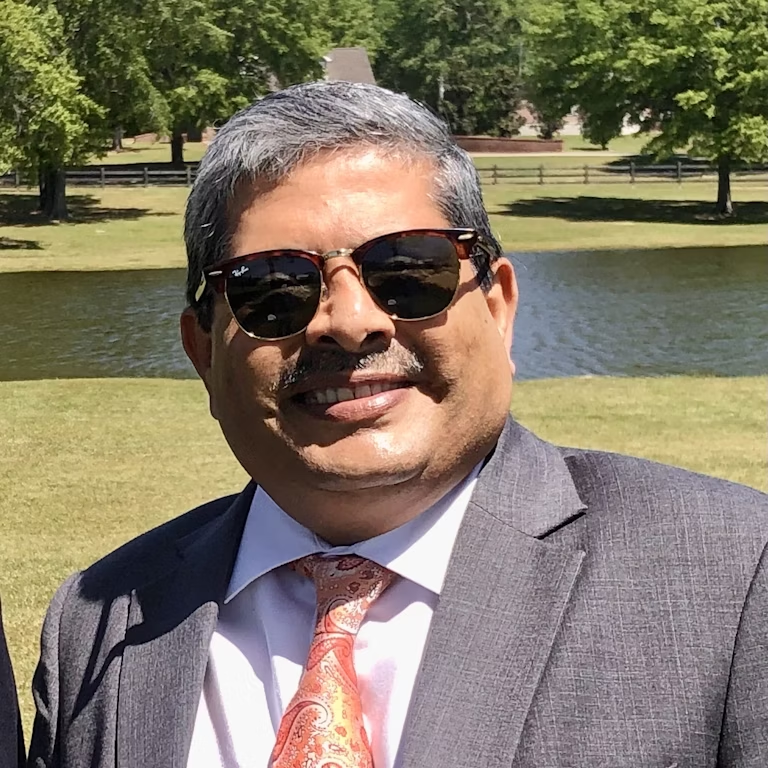
Vibhore Arora: CEO, Farmers Edge (Original Image provided by Farmers Edge. Artist rendering by EI)
RP: Having worked at Amazon, I can draw parallels between what you could learn from Amazon and bring here. One of the big things about any company and its success is the culture of the company. What are the principles and values? Amazon does a good job of their leadership principles. “Being frugal”, “Being right more often”, “Disagree and commit” etc. What have you tried to bring to Farmers Edge from Amazon and what have you left behind?
VA: That's a great question. Every organization's fundamentals rely on building the right culture. For me, a simple definition of culture is values plus behaviors. When I joined Farmers Edge, the company was navigating its first year as a public company and trying to scale quickly. We needed to accelerate our speed, but we also had to establish the right culture from the ground up.
I greatly admire Amazon's leadership principles. Amazon has done an incredible job defining and operating with those principles at scale. I directly drew from my experience there. At Farmers Edge, we launched the One Farmers Edge plan, which revolved around seven key values.
We prioritized customer experience. I chose not to use the term "customer obsession" because "obsession" feels a bit extreme. The company had been building solutions we believed were the right fit, but we hadn’t done enough to listen to our customers. I made it a priority to change that immediately.
We added customer experience as a core value in the One Farmers Edge plan. Another key value we introduced was making data-driven decisions. Whether it’s a business model, a new idea, or an innovation, data must guide decisions. We also paired data with anecdotes to enhance our decision-making.
Despite having a robust software stack, I believed we could improve our use of data, so we made data-driven decisions the second core value. The third value, similar to Amazon’s "Bias for Action," became "Rapid Action" at Farmers Edge. Given we were undergoing a turnaround, we needed to move faster.
Over the past two years, I’ve felt incredibly proud of how the team has embraced these values within the One Farmers Edge plan. The journey has been remarkable. With our new approach and strategy, we feel extremely confident about the road ahead.
The Farmers Edge intersection
RP: Let us talk about your strategy. You say Farmers Edge is at the intersection of data, technology, and agronomy. If I'm a customer, what should I think about the intersection?
VA: I attended the World AgriTech conference in San Francisco in March 2024. AgTech is an incredibly crowded marketplace with over 2,000 companies competing for attention.
Several clear themes emerge when addressing adoption challenges in AgTech. Companies have made the value proposition too complex, or they’ve failed to meet customer expectations. When I joined Farmers Edge, I analyzed the business to identify our strengths. We bring deep expertise in agronomy, manage over 50 million acres of data, hold 19 patents, and operate in three countries - Canada, US, and Brazil. By combining the depth of our agronomy experience with our data, technology, and architecture, and integrating it into our new managed services solution, we’ve built a complete, holistic skill set.
We operate across two key dimensions: agronomy and technology. Our rich datasets provide a foundation for developing advanced machine learning models, harnessing insights, and creating value for customers at any stage of their digitization journey—whether they are newcomers, advanced users, or somewhere in between. This comprehensive capability sets us apart as an organization.
We’re focused on simplifying and delivering our value proposition in a way that resonates more effectively. By doing so, we aim to create a stronger, more impactful connection with our customers.
Transition to Managed Services
RP: You believe you have a strong base of having worked across so many different acres, strong agronomy experience, a solid software stack, and you have the data to provide informed decisions. You mentioned managed services. What are managed services?
VA: As a customer, if you want to begin your digitization journey through solutions like sustainability, farm management, or e-commerce, who should you turn to? Should you go to a company that excels only in technology, or to one that specializes in agronomy but lacks technology expertise? Or should you choose an organization that combines the strengths of both?
At Farmers Edge, we offer that combination. Let’s be honest—our company has faced its share of challenges and gained “scar tissue” from field experience. Over time, we’ve built intellectual capital under one roof, blending agronomy and technology expertise. This combination sets us apart.
Managed services form an essential part of our offerings and lead the way as our flagship service. Through managed services, we stay with you throughout your digitization journey. Unlike typical product companies that deliver a solution, implement it, and then leave you to manage it alone, we provide end-to-end support. We design the solution, implement it, manage it, and maintain it throughout its lifecycle.
As your business evolves, we adapt the technology to meet your new needs. Just like businesses transitioned from managing on-premise data storage to using the cloud, we enable you to achieve the same flexibility without the hassle of managing costly and inefficient technology. Scaling often increases technical debt, but with managed services, we become an extension of your technology team, reducing risk, cutting costs, and accelerating your speed to market. Our goal is to position ourselves as a strong, capable technology partner with unmatched agronomy expertise.
We’ve also shifted our approach to complement the broader ecosystem, which represents a departure from how the company operated in the past. We take full responsibility for managing your technology. Simple. Managed services consist of three main components: consulting, outsourcing, and technology.
The first component, consulting, helps businesses navigate their digitization journey. If you’re unsure how to start, we use our extensive experience across solutions—crop insurance, sustainability, carbon programs, farm management, ag-retail—to establish a roadmap tailored to your needs.
The second component, technology outsourcing, focuses on reducing costs. If your agriculture or crop insurance company has built technology but struggles with high maintenance costs, we can step in. By assuming the scope of work, we deliver cost savings of 30–50% immediately. We maintain your technology team remotely while partnering with companies like LTI, Mindtree, and Google to ensure high-quality service at a competitive price. This eliminates the hassle of hiring and managing technology staff, which isn’t a core focus for most agriculture companies.
The third component, technology development, includes white-label solutions and custom-built technology. We can white-label our suite of solutions for you, allowing you to launch a branded digital platform within six to eight weeks. For agriculture CTOs grappling with the “build vs. buy” decision, we offer a hybrid approach. Instead of hiring developers to build technology in-house or settling for off-the-shelf products, we custom-build technology based on your specific requirements. We collaborate with you to define the scope, translate it into features, and deliver a tailored solution that provides flexibility to scale up or down as needed.
To summarize, our managed services include three core components: consulting, outsourcing, and technology development. We’re confident this positioning meets the needs of our customers and creates exceptional value.
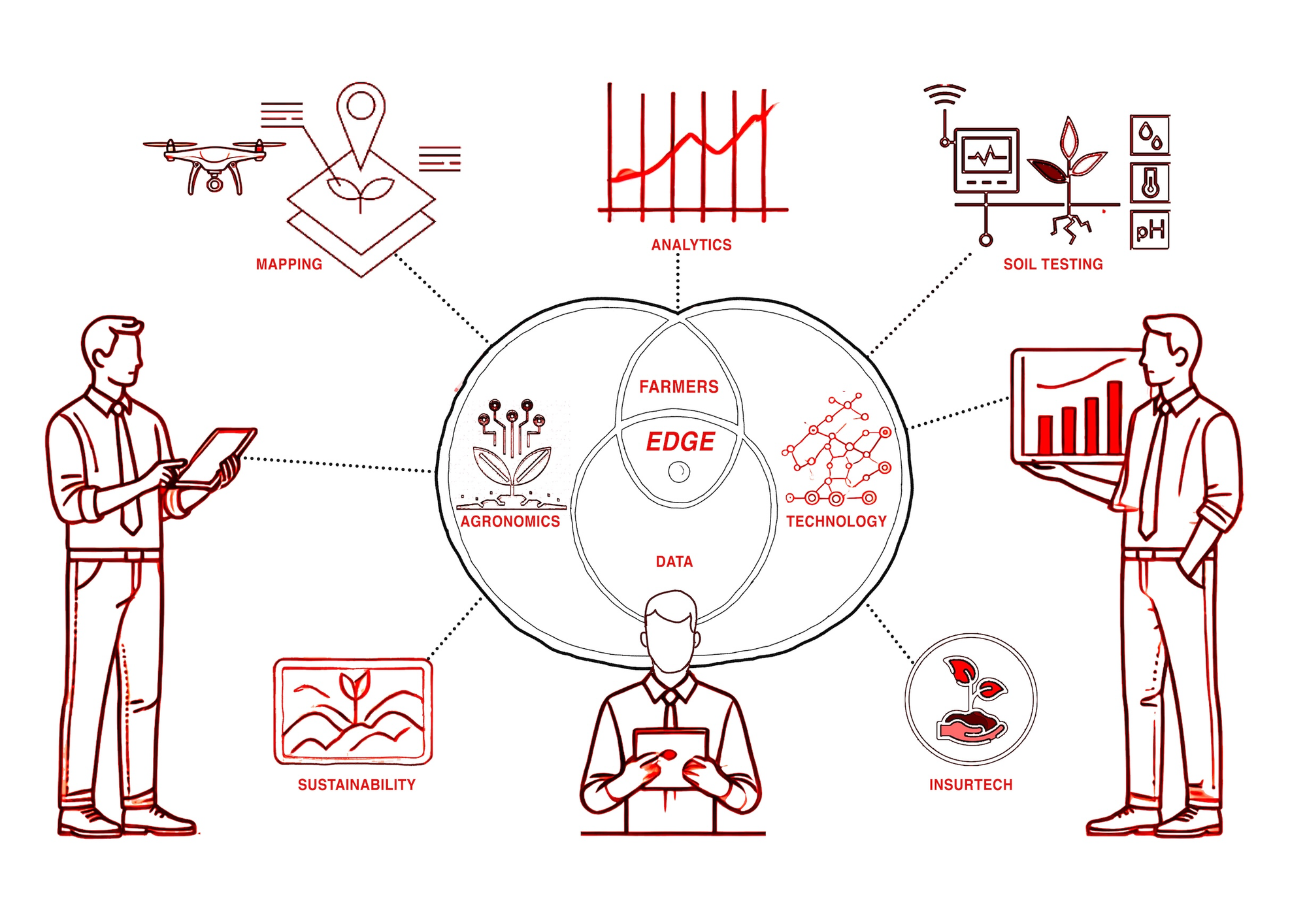
Managed Services model from Farmers Edge (Artwork by EI)
RP: What prompted the shift to managed services?
VA: Throughout my professional journey across different industries, I’ve noticed that some business fundamentals remain consistent.
One key fundamental for creating exceptional value is understanding and listening to what the customer wants or needs—and even identifying what they don’t yet realize they need. Last year, my VP of enterprise partnerships and I hit the road, traveling nearly 80,000 miles and meeting with over 100 customers in agribusinesses, ag retail, and co-ops.
Initially, we focused on selling our product solutions to these customers. As the discussions progressed, we realized these companies genuinely wanted to digitize but struggled with how to operationalize their vision. The notion that “adoption is an issue” in ag tech or agriculture is a myth. Customers absolutely want to adopt digital solutions. The problem lies in the absence of a viable pathway—one that’s risk-free, cost-effective, and seamless. They lack a trusted partner to guide them, so we shifted our focus to solving that specific problem.
Our target customers are CTOs in agriculture companies, heads of digital, or CEOs tasked by their boards to leverage technology for business improvement. These companies often face disconnected tech stacks, data silos, and high costs associated with managing technology. Even when they figure out the technology, organizational change management becomes a significant challenge. Employees resist altering familiar processes, complicating the transition.
This insight gave rise to managed services as a solution. We do the hard work and heavy lifting so our customers can focus on achieving the business benefits they seek.
Business Model Evolution and Change Management
RP: Are you trying to become an Accenture or a Deloitte of AgTech? Your business model is different from selling a software product, The margins are different. This is a people-heavy business. How have your investors reacted to this change? What has been the impact on your customer mix with a different go-to-market and business model?
VA: I think this is a great question. I proposed the idea of launching a new business model to Fairfax based on customer feedback. When you solve a problem at scale, it creates economic value, and the financial results naturally follow. For me, it’s not about starting with a financial case. I focus on solving problems at scale, with the economic outcome as a byproduct. Fairfax, especially Prem and board chair Bill, has always prioritized creating exceptional long-term value through their investments.
Their guiding principles align with this approach. They focus on building strong companies with the right customer orientation and fundamentals to create lasting value. They were extremely receptive to the new pivot we proposed.
In April 2024, we decided to take the company private. Navigating strategic changes and restructuring is more effective in a private setting. Once the business model is solidified, we can explore future options. I’ve received tremendous support from Fairfax, which would have been a different experience with a private equity investor.
Every investor has their own philosophy, but Fairfax’s values align closely with mine. I feel confident and supported in this partnership.
Now, to the second part of the question—how have customers responded? The response has exceeded our expectations.
Over the last two years, I’ve seen customer fatigue with technology in agriculture. Many customers feel let down because companies failed to deliver on their promises. We’ve addressed this by guiding them through the change management process of digitization at almost lightning speed. In four to six weeks, we can take customers from having no solution to a fully operational solution. This approach opens up countless possibilities for them.
We’ve built trust with customers of all sizes—Fortune 500 companies, mid-size businesses, and smaller co-ops. Our mission is simple: we want to support anyone who wants to digitize but lacks the expertise, bandwidth, or scale to do it on their own. The feedback from our customers has been exceptional, and we’re proud of the trust we’ve earned.
RP: Earlier you were selling pure play software, precision ag services. With this transition, what does it do to your internal technology processes? Do you still think of the software as products or is every customer bespoke? Are you the Accenture of Ag?
VA: When discussing the big four consulting firms or large system integrators, we complement their work rather than compete with them. Consulting firms excel at strategy but often lack execution experience. In contrast, we bring extensive hands-on experience in agronomy and field execution. We’ve managed millions of acres across the U.S., Canada, Brazil, Australia, Ukraine, and Russia, though we currently operate only in the U.S., Canada, and Brazil. The expertise we’ve accumulated through our data models and solutions adds significant value.
We strengthen the domain expertise of consulting firms and system integrators, and we stand out as a standalone provider due to our unique combination of strong domain knowledge and technological capability under one roof—a rarity in the industry.
Our lead offering, managed services, primarily targets enterprise customers, though we also have some direct-to-farmer business. While we’ve experimented with the direct-to-grower model and seen others attempt it, the fragmented nature of agriculture and the diverse needs of growers—even those running the same crop—make scalability a persistent challenge. A more effective pathway involves partnering with enterprise customers. For example, a co-op in Iowa could onboard 5,000 growers onto a single platform, streamlining adoption and scaling efforts.
These enterprise customers seek a partner capable of guiding them through the change management process of digitization. Even a company like NVIDIA partners with Accenture because manufacturing and shipping GPUs is one thing, but implementing solutions and helping customers adopt them requires a service partner.
Drawing parallels to AgTech, we aim to serve as an end-to-end service partner, helping companies navigate change management while building and implementing the solutions they need.
RP: That's a pretty significant pivot. You've gone from a product to a services company. Your go-to-market has shifted to a B2B model. Let's pick a particular customer type from risk management, farm productivity, sales enablement etc. which you list on your website. How are you helping them through their digitization journey? What are you bringing to the table? What are their needs?
VA: Let me give you an e-commerce example—it’s easy to understand, and we’ve seen great success in this area. We collaborated with a large co-op that wanted more than just a digital front-end for conducting e-commerce transactions online. Traditionally, transactions happen manually—you take the order, ship it, and there’s little to no system integration. However, this co-op was more advanced, and we thoroughly enjoyed working with them.
We provided a front-end solution for their e-commerce operations that went beyond a simple, branded website. The platform we built included all the necessary components for a seamless transaction experience. It ensured the level of product selection was appropriate for smooth buying, which in turn fueled a positive feedback loop, or "flywheel," for their business.
At the same time, we integrated the platform with their backend ERP system. This meant they didn’t have to manually manage inventory, supply chain, and ERP operations in the background. Within six to eight weeks, we expedited the project from inception to launch. The platform allows them to make quick pricing adjustments, run marketing campaigns, and implement various promotions. It transformed them from just thinking about "having an online presence" to possessing a fully functional and robust e-commerce capability in a short timeframe.
Through this process, we didn’t just provide a technology solution; we actively contributed to their success with a consultative approach. By sharing our insights, we helped them bypass the learning curve and avoid the mistakes we made when launching our own e-commerce platform.
We added significant value by working closely with their team to scope, ideate, and finalize the solution. Together, we determined the look, feel, and mechanics of the platform, as well as its backend functionality. Now, they’re fully operational and thriving. They enjoyed an excellent holiday season with strong input sales that met and even exceeded their expectations.
Headwinds and Tailwinds
RP: Technology obviously brings a lot of efficiency. Are you seeing any difference in demand or what customers are looking for because of some of the current headwinds the sector is facing when it comes to your managed services business?
VA: That’s a great question. Our technology outsourcing category within managed services emerged as a solution because we identified the need early. While I wouldn’t say we predicted the future, we started noticing patterns well in advance. For instance, despite a successful growing and harvest season in Canada, customers continued to feel inflationary pressures. Something had to give.
We positioned ourselves to address this challenge by offering a solution to larger organizations. We tell them, "You can retain your capability, and we’ll help you do it at an optimal cost." This approach has driven a surge in inquiries about technology outsourcing—how to maintain capabilities without incurring the high costs they’ve been accustomed to.
This offering is one of our core strengths, allowing customers to immediately reduce their technology spend by 30 to 40%. They don’t have to wait a full cycle or two years to see the benefits. The savings are realized right out of the gate, making it an impactful and timely solution.
RP: What are some of the headwinds for managed services?
VA: We formally launched managed services at World Agri-Tech 2024 and have since accelerated efforts to educate our customers. Through the thought leadership content on our website, we address these challenges and demonstrate how we can help customers solve them. The primary challenge lies in educating customers about how the managed services model works.
Coming from a technology background, I understand the importance of simplifying the value proposition for companies in different industries. Customers need to see clear benefits—what is the ROI? How will it impact their business? Will it de-risk operations or introduce new risks? We tailor our conversations based on customers’ concerns and identify what might hold them back from their digitization journey.
In most discussions, we’ve been successful in alleviating customer fears. If we can institutionalize education around managed services, we’ll position ourselves much better in the market.
RP: Do you feel that you are still innovating either on the business model, or the technology side, when it comes to managed services?
VA: Every company must innovate. When we think about innovation in products and services, managed services represent an innovative business model. To test innovations quickly and fail fast, we focus on product-market fit by asking customers, "If this offering didn’t exist, would it concern you?" That’s precisely what we’re doing with managed services.
Take our FarmCommand platform, for example—a core solution for farm management. We collect 3 billion data points every hour from various hardware and software systems, feeding them into an AI model. As the ecosystem evolves, we will continue advancing this platform to meet customers’ needs.
RP: Selling a software product requires different skill sets than selling a service and marketing it. How have you thought about the available talent pool and how have you managed the switch?
Finding people with both agronomy and technology experience is challenging because, quite simply, that combination doesn’t typically exist. I don’t have a background in agriculture, but I do have technology experience. Within our team, we’ve achieved a strong balance between Ag experts and technology experts.
We approach solutions with a balanced perspective, integrating agronomy and technology expertise simultaneously. This approach sets us apart from a typical tech company. Anyone can write software—even AI can write software—but they cannot replicate the in-field agronomy experience we bring to the table.
We feel confident about this approach while recognizing there’s still room for improvement to get even better.
RP: Vibhore, thank you for your time!