SFTW Convo: Technology that lives in the field with Léo Carvalho
Conversation with Chief Strategy Officer for Solinftec
Welcome to another edition of “SFTW Convos” with Léo Carvalho, Chief Global Strategy Officer for Solinftec from Brazil.
During my “SFTW Convo” with Feroz Sheikh, Group Chief Information and Digital Officer (CIO and CDO) at Syngenta Group, I asked Feroz how he thought farming was going to change in the next 5-10 years.
One of the other things I think is going to happen is AI will start to make the machines more autonomous. So we will start to see a little more of autonomy at precision. And when you take away the human factor, when the machines are operating autonomously, then you can imagine a sci-fi world of a swarm of robots operating in the field 24 x 7.
Then you don't need to have a very heavy machine that goes out in the field once every four weeks and has to spray a broadcast at that time. The autonomous machines can operate in the field and take an action instantly when they see a thing. So I think some of those can possibly be the future where we'll see novel practices, novel agronomy come into practice enabled through technology.
You will get a peek into this future through my conversation with Léo Carvalho of Solinftec. Solinftec is working on reimagining the future of farming, through their autonomous, electric robots which can 24x7 “live in your field.”
This LinkedIn post (Dec 9 2024) from Solinftec’s CEO, Britaldo Hernandez is very timely.
Agriculture relies on large machinery and chemical products, with a few dominant companies playing a crucial role in feeding the world for over a century, highlighting the essential and non-negotiable need for food.
Current agricultural solutions focus on short-term food production but often create larger future problems due to limited options and reliance on existing practices, such as smarter machines, AI-driven prescriptions, and new chemicals. While these innovations sustain us temporarily, they don't address agriculture's core challenges. The key question is: if we could start from scratch, how would we design solutions? With generative AI and modern technology, we could shift toward systems that feed us sustainably without exacerbating future issues.
Solinftec is already leading this shift with its “technology that lives in the field,” addressing key factors like cost, security, and sustainability.”
My conversation with Léo, goes into imagining a farming system from scratch. I hope you enjoy the conversation.

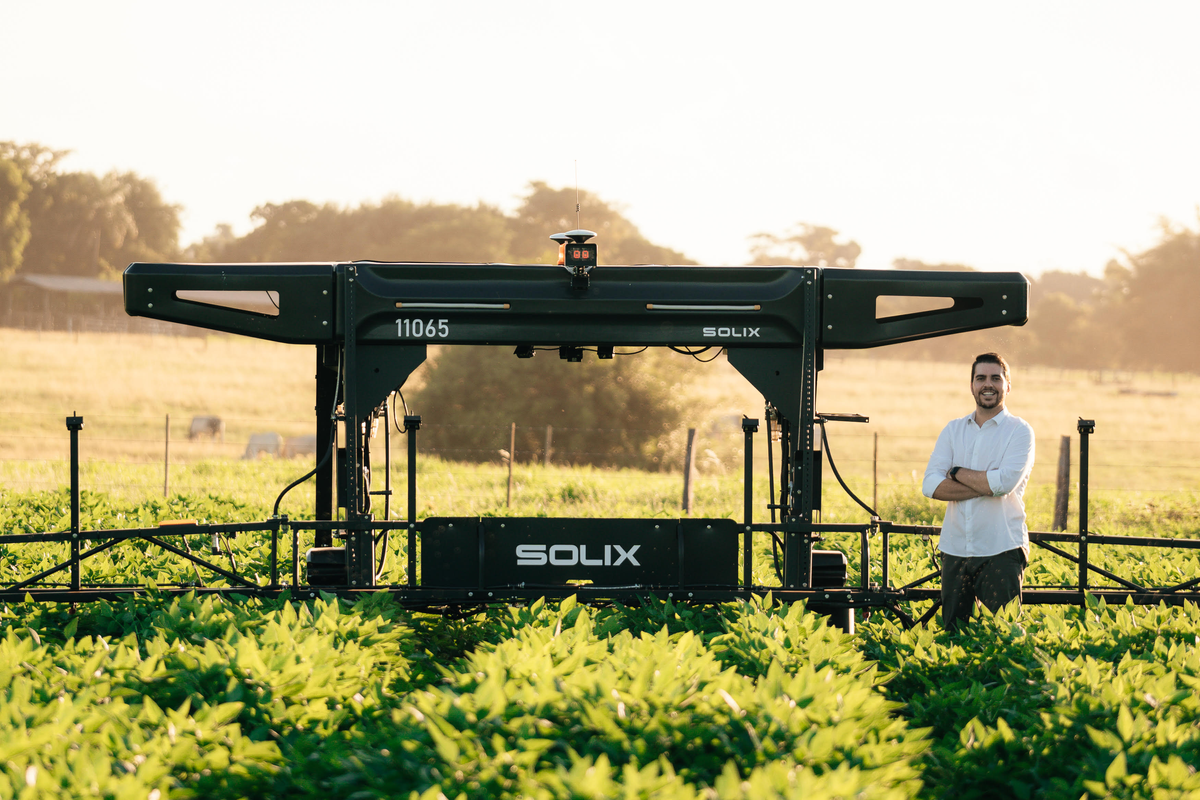
Léo Carvalho with the Solix sprayer (image provided by Léo Carvalho)
Operational Efficiencies through Solinftec
Rhishi Pethe (RP): Solinftec started with sugarcane and expanded to other crops. What is your business there, and what problem are you trying to solve in the sugarcane value chain?
Léo Carvalho (LC): It’s very important to note that Solinftec operates as a non-traditional company. We use technology to solve different kinds of problems in agriculture.
We face two challenges as a society—not just for our company: food security and climate change. We approach these issues using technology from an agronomic and agricultural perspective.
We developed onboard computers to install inside machine cabs to collect real-time information and provide insights to farmers for better decision-making. But we understand that merely providing information isn’t enough; we also need to act at the same time.
Because of this, we created different solution layers. We began by using our proprietary hardware to monitor field activities. This involves tracking machines and associated processes in the fields. We then added layers such as logistics, traceability, and weather integration, consolidating all the information into a single platform.
Later, we realized we lacked an agronomic layer, even though we had a complete understanding of what was happening with the machines. While we knew where the machines were and their quality, we hadn’t observed what was happening with the plants themselves.
To address this, we created autonomous robots that operate in the field to complement our ecosystem. We designed these robots to live in the field 24/7, inspecting plants day by day. They enable us to not only identify and solve problems but also verify whether the solutions were effective. This approach has changed how farmers perceive their work.
RP: In the first few years, you focused on data collection, analysis, and logistics to improve supply chain and operations. You work with 95% of sugarcane growers in Brazil and the top five grain producers, managing 18-20 million acres of cropland across multiple crops. If I don’t use the robot, how does Solinftec impact my business?
LC: When you install our onboard computer inside a machine’s cab, it uses AI to understand what’s happening in the field and provides insights for the best decisions. The first impact comes from reducing fossil fuel consumption, as we optimize machine efficiency.
In Brazil, where large fleets of machines operate, we make each machine more efficient and reduce the total number of machines required. This results in significant savings in fuel consumption and operational costs.
We also create savings through traceability. When you can trace 100% of your production—be it grains or sugarcane—you add value to these products. Additionally, by considering weather information in decisions, such as when to use sprayers, we minimize wasted time and chemicals. For instance, sprayers often lose time due to bad weather or inefficient reloading schedules. We provide machine-to-machine communication alerts to optimize their operation.
RP: So, you focus on improving operational efficiency. I read an example where someone reduced their equipment footprint from 250 machines to 220, which is significant.
LC: Exactly. In Brazil’s sugarcane market, it’s common to use one combine and two tractors. But in reality, you only need 1.7 tractors. Our system creates logistics that support continuous harvesting without stopping combines, making tractors more efficient and reducing redundancy.
RP: You need connectivity in the field for this to work. Connectivity is a challenge, especially on farmland in remote areas. You built your own SolinfNet capability, which integrates with other hardware. Building your own network requires significant investment. How did you determine that the investment would yield sufficient returns based on the products you sell?
LC: We solve the problems in front of us. Connectivity remains a major issue in many parts of the world. In Brazil, when we started in São Paulo, connectivity wasn’t much of a problem. But as we moved to row crops in central Brazil, we faced significant connectivity challenges. To sell our real-time products, we created SolinfNet, our proprietary network.
We built SolinfNet to support our products. It uses small towers and low-cost radio frequency to establish end-to-end communication. The towers relay information from the machines to the cloud through our hardware, creating a connectivity environment that keeps machines online for real-time decision-making.
The payback was challenging because we needed to maintain low costs. Without low costs, we couldn’t sell our technology. But the project succeeded before Starlink launched. We implemented many projects across northern and central Brazil using SolinfNet. Now, we also send some data through Starlink while continuing to rely on SolinfNet. Solving our own problems drives our innovations.
Autonomous robots - Solix
RP: Over the last few years, you’ve expanded into robotics. Many companies start in the U.S. and then expand to other markets. You started in Brazil, now operate in more than 10 countries, and are expanding in the U.S. How do you decide when to enter a new market, and what factors influence that decision?
LC: With sugarcane, we first gained a strong market share and built a robust platform in Brazil before expanding to other crops and regions. Before entering new markets, we test our products thoroughly in Brazil.
We’ve learned that we can’t localize products exactly as they are. We must adapt them to real conditions. Colombia was our first international market because its sugarcane industry shares similarities with Brazil’s.
Afterward, we focused on the U.S., starting in Florida with sugarcane before expanding to the Midwest. Our step-by-step approach involves leveraging our strengths, learning about new markets, and adapting solutions to local realities. For instance, our robots already run in both the Midwest and Brazil. We use this dual presence to exchange information and refine the technology.
While crops like soybeans differ slightly between the U.S. and Brazil, they’re commodities, so training AI doesn’t depend on geography. We focus on adapting to each region’s farming challenges, such as varying farm sizes and government incentives, while ensuring our solutions remain relevant globally. But at the end of the day, we know we need to make the farm more efficient. How can we do it using technology? And the robots are the answer for this question.
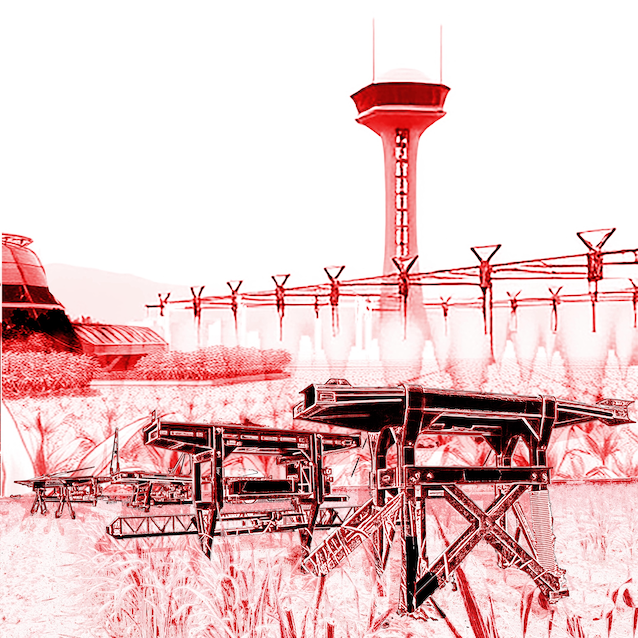
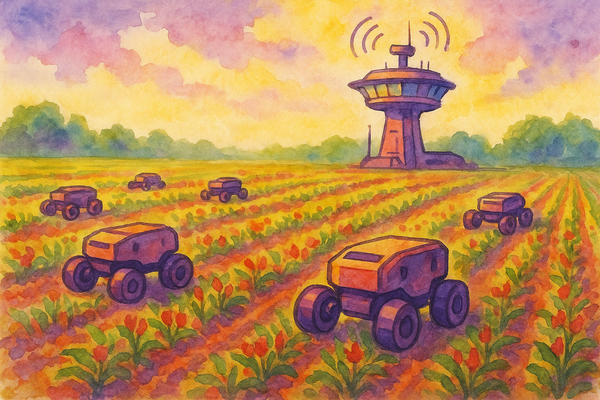
Multiple robots “living in the field” (artist interpretation by Eeshan Inamdar)
RP: Your approach differs significantly from others. You’ve built connectivity, created your own data collection mechanisms, and are proposing a new way to farm. Why did you decide to develop robots for data collection instead of relying on precision data from existing equipment like combines or sprayers?
LC: The existing data makes us efficient today, but it only captures information when machines are in the field. Agriculture requires more dynamic and continuous data because plants change daily due to wind, rain, and their biological cycles.
Combines, for example, pass through a field once a year. Sprayers may cover fields two or three times a season. This isn’t enough. Robots solve this problem by continuously collecting real-time data, detecting daily changes, and responding immediately without requiring large, heavy machinery that compacts soil and consumes fuel.
Our robots adapt to nature rather than forcing traditional agricultural methods to fit. They gather data, act on problems, and confirm the success of their actions, all while minimizing chemical use and environmental impact. This technology represents the next step in agriculture.
We see many traditional components in the market right now. Different sensors, putting a lot of technology in the existing machines. It helps but does not solve the problem. In our case, we decided to put a robot which is autonomous, light, constantly gets information, understands the problem, and acts at the same time, and checks if the action worked. It eliminates fossil fuel, uses less chemicals and gives a far greater chance to be profitable.
So I'm not saying all the information you collect is for nothing. I'm saying it was good till today. I believe the next step is to solve the biggest problems of food security and climate change. It is to rethink the way we are growing food. We need a new kind of technology.
RP: People have tried to solve the data collection problem with satellite imagery. Are there certain types of crops or farming systems where you think Solinftec’s approach is more suitable?
LC: As a mission for the company, we put our efforts to work at the food base. We are talking row crops like soybeans, corn, wheat, and rice. For example, there is no one running robots in these crops.
Why? Because it's quite hard.
For example, we see many kinds of the robots in California running in small fields which the guys can refill automatically, recharge the battery and continue running scenarios in controlled fields.
Strawberries are good, but they are not the base food of the world. We can make this kind of farming efficient, but the impact for the world is smaller.
So, we put our efforts on row crops, but we can use this technology in different specialty crops. For example, we have robots running in tomatoes because we create a frequency of the light which can attract pests and kill with electric shock to eliminate pesticides. It is profitable and makes the farmer happy. But when you see the entire environment, how many tomato producers are there and what is the impact? We do want to make farms efficient, but we also want to create an impact on society, in terms of food security and climate change.
Farming reimagined
RP: Your robot costs $50,000, which is much less than a million dollar combine or a $400,000 sprayer. Leaving the robot in the field is one approach. Drones are another approach. When you think about the overall problem, it might be a combination of different tools and approaches. Do you think a portfolio approach would work? Or do you feel a tool like Solix, replaces these big pieces of equipment, especially sprayers?
LC: In the short term, replace.
But we need to improve many things day by day. When you talk about electric cars, the first car Elon Musk made was $1 million. And right now he’s selling for $ 20-30K because the technology has evolved to give more access and more comfort to users. Today, Solix is doing the scouting process, the herbicide process, it can recharge and refill automatically. We are pretty close to replacing ground based sprayers with this technology.
It will take time because we need to evolve as a company. The average farm size in North America is 300 acres. The farmers who have 300 acres cannot pay for a ground rig sprayer. They need to hire some custom applicator or share a sprayer or buy this kind of the sprayer and pay for a long life, never thinking about the payback of the machine.
I'm not saying we need to pass with some machine or some drones to analyze one day and be back another day to take action. For example, let us talk about fungicide. Many American farmers don't do fungicide applications. You know why? Because of timing. Not because they don't want to do it, but because of the timing.
But if you have a technology which can make autonomous tests, use a different quantity of the product and check the results in five days, we will change the way you do agriculture.
Because of climate change, the agronomic windows are reducing day by day. If we have a large machine, it won't solve my problem. On the contrary, we have more compaction in my fields, I'm wasting more product, I'm using labor. It does not solve our future problem.
We need to rethink and that's what we are proposing. It is a different approach with a different technology.
RP: In North America, you are working with ag retailers, whereas in Brazil, you work directly with growers. How do you think your business model and go-to-market approach?
LC: The technology is always focused on the farmer. The farmer has a voice to decide what they want to do and the way they want to pay.
In Brazil, the farms are large. The farmers here can afford this kind of technology. We are creating these products to be inexpensive to make them accessible and feasible for the farm. We can sell straight to farmers in Brazil. When you talk about the US market, I can sell to American farmers as well. We allocate part of our production and put it in the hands of American retailers because the retailers decide to use our products to provide a service for the farmer.
Right now, agriculture retailers survive with rebates from the chemical company. With our robots, they can reduce 95% of herbicide for farmers. In a traditional business, they lose a lot of revenue. But with our robot, we give them the opportunity to charge clean-fields-as-a-service, instead of charging for the chemical. And the farmer, as a customer, receives a report everyday for scouting, as-applied, what’s happening in the field etc. At the end of the day, we make the farmer more profitable.
We can make farmers more profitable. But part of the value chain gives us access to more farmers? In the US, it is the agriculture retailers. We have been selling straight to farmers, the same way we do in Brazil. The same approach works in Canada as they have large farms.
If you put farmers at the center of this decision, it is easy to understand what's happening around them. And we don't want to make farmers more addicted to using what they are using currently. Five brands of the machine, five brands of the seed input. We are giving them a third option which can make them free from traditional agriculture.
A new business model
RP: For a retailer to say, I'm going to buy or lease Solix robots and provide a clean-field-service to my growers, it is a big mind shift.
If you're used to all the rebates and if by using Solix, an ag retailer is going to lose 95% of their chemical sales, how do you make sure the incentives of Solinftec, of the ag retailer and the farmer are aligned?
LC: There are three different perspectives.
Farmers have more yield, more information, and are more profitable.
For retailers, we need to give them a chance to create the upside of services for scouting, fungicide & herbicide application, monitoring in real time, etc. For retailers, we need to create a portfolio of capabilities to give them a chance to increase their sales.
The robot could be a lease, or could be sold. In Solinftech’s perspective, we want to reach farmers by using just one channel, which is retailers. We want to support our channel to go to fields and farms. At the same time, we can sell it straight to the farm. If the farmer has 80, 100 acres, the payback of the robot is one and a half seasons. So it is totally feasible for farmers.
RP: Typically technology is deflationary in nature. If I'm a retailer and I look at my total revenue across input sales, and the services I provide, do you expect a retailer using Solix robots to have a decline in total sales? What about margins?
LC: The simple answer is we can turn 80% of the revenue of the retailers from chemicals to service. We can replace selling products and their rebates to high margin services. The chemical margins are compressed. We have decided to get retail partners and for them to provide them to their customers. It is a good channel for us.
RP: If I'm a retailer, it is a completely different business with 80% services vs. 80% inputs. How you sell, who you hire as a salesperson, who is on your team - everything has to adapt and change. It is a big drastic change.What are you doing to help them transition?
LC: The person responsible for a change of mind is the farmer, when they see the results in real life. It is our responsibility to create a business model, where the math works for them. We create support for retailers, their operations, and the farmer’s operation. The decision ultimately comes from the farmer.
As a farmer, I have a good, clean field. I have more yield this year. I want to keep using the robot next year, instead of a ground rig sprayer. As a company, we need to support them, create a rationale for them which works and show the future. For example, we have one customer in South Indiana who started with one robot. Next year they bought 10 robots and for 2025 they bought 25 more robots.
We are showing them what we are developing with real delivery and not just promises. They are coming back with repeat demand and it makes us confident.
RP: Maybe the human resources an ag retailer has access to in terms of skill sets, technicians is limited. It could be a potential challenge to think through.
LC: When you see the robot in front of you, even the farmer who doesn't have too many technical skills, says “This seems like what I know: solar panels, batteries, some engines, and a big boom.” It does not seem so strange. There are not too many parts to replace. The robot is cheap because our development team created something easy to replace.
Imagine we put the robot in a box and send it to different countries. The farmers need to be able to fix our robots and need to buy some parts and replace them automatically.
All the reports and results come through an iPhone or smart phone. It is easy. At the end of the season, they can see their field results. When they see higher yields, with less chemical, and not a lot of soil compaction, they understand what it is capable of doing.
RP: In the US, people say farmers don't like subscription models. And it looks like this could be a potential subscription model from a retailer to the farmer. What feedback have you heard in the US?
LC: I don't know who said it, but I agree. But the reason is because the farmers have never received something real to make them profitable. When you provide something profitable, they will pay for it.. Imagine we can make them $100 more per acre and the retailer charges them $ 5 per acre, they will pay. When you start to show them profitability, more yields, they are able to pay.
Future gazing
RP: How do you think the traditional OEMs are going to respond or are responding to what you're doing? This is a different approach than what a traditional OEM does, which is bigger, stronger, more horsepower.
LC: I believe they will change their mind in the short term. Solinftech was the first company to create an approach of a smaller machine in the field. We don't need large machines, we need smaller machines. We need an intelligent, smart kind of application. We need some things to live in the fields.
The traditional OEM companies need to rethink the way they are doing business. I believe all the OEM companies will adapt their business model, their knowledge, their approach. We are adapting our technology to the biological cycle of the plant, not adapting our technology to traditional agriculture. And this is the mindset OEMs will change. Stop putting a lot of technology inside of the tractor, inside of the combine, inside of the drones and rethink the way of providing service.
RP: What are the plans for you personally and for the company over the next 12 to 18 months?
LC: I believe this technology will get more traction. We expect to give the African continent access to this kind of technology. We know Brazil will be responsible for feeding 20% of the population. The US has a real responsibility to produce more food. But I believe Africa, as a continent, has a lot of potential. But right now, they don't have education, access, and technology. We hope to give them access to it as a cheap technology, a profitable technology, and easy to use in the short term. We understand many countries in Africa are able to produce more food for the world.
RP: Thank you for a fascinating conversation.
Relevant previous editions
- SFTW Convo with Feroz Sheikh, CDO and CIO of the Syngenta Group (Nov 13, 2024)
- Autonomous Equipment: Subsidies & Labor (Nov 10, 2024)
- The Fusion Frontier (May 5, 2024)
- The Labor Dilemma (Mar 17, 2024)
- Let a thousand robots actuate (Oct 30, 2022)
- The unbundling of humans in agriculture (Aug 15, 2021)